-

Eurasian Wigeon – Anas penelope
Ómar Runólfsson, Eurasian Wigeon – Anas penelope – Rauðhöfðaönd. Creative Commons BY-NC-SA-2.0
Ómar Runólfsson, Creative Commons Attribution Noncommercial Share-Alike 2.0
Eurasian Wigeon
(fi: haapana, sv: bläsand)
Anas penelope
Eurasian Wigeon’s whistling call is heard from the freshwater wetlands, coastal marshes, and estuaries rich in plants.
Identification
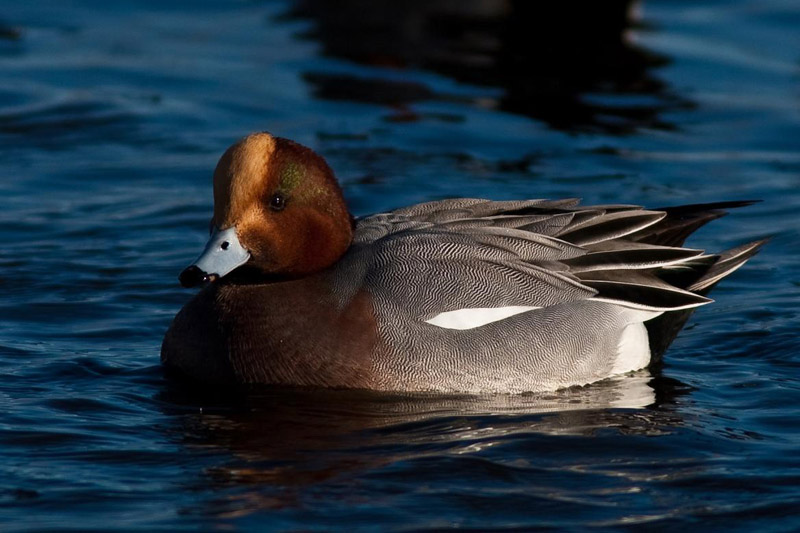
Eurasian Wigeon is a medium-sized duck with a blue-gray bill, black tip, and gray legs. When in flight, it shows a green and white wing patch. Females are brown with reddish tone. Males have a cream crown, chestnut head, and gray body. Listen to the Eurasian wigeon’s call by clicking the button above.
Habitat
Eurasian Wigeons are typically found on freshwater wetlands rich in plants, open grassy areas with scattered trees, coastal marshes, and estuaries with plenty of underwater vegetation.
Nutrition
Diet is almost entirely plant based. Forages by grazing on land, by dabbling at surface of water, and sometimes by submerging head and neck.
Breeding
Breeds on shallow freshwater bodies like boreal forest lakes, marshes, and tundra pools. It nests on ground, under dense vegetation near water, in Russia and Scandinavia.
Migration
Eurasian Wigeons migrate from northern areas like Scandinavia and Russia to southern wetlands, where they overwinter. In spring, they return north to breed. In Finland they observed that they migrate earlier in the spring than before, due to climate change.
Distribution
Eurasian Wigeons are found across northern Europe and Asia, especially in Scandinavia and Russia. In winter, they occur in western and southern Europe (Romania, Italy, Slovenia), parts of Asia, and North Africa, mainly in suitable wetland areas.
Status and conservation
IUCN status is Near Threatened. Main threats are wetland loss and degradation of habitats. Conservation focuses on habitat restoration and preventing habitat losses. In Finland it is Vulnerable due to eutrophication and habitat overgrowth.
Cultural heritage
Its latin name “Anas penelope” comes from Greek mythology, where Odysseus’s wife Penelope was said to have been saved by a duck. In Finnish tradition, waterbirds are linked to creation myths, where the world is believed to have formed from a waterbird’s egg.
Explore the factors affecting the species
Organism groups
Endangered status in Finland
ENDANGERED CATEGORY (International Union for Conservation of Nature (IUCN) classification)
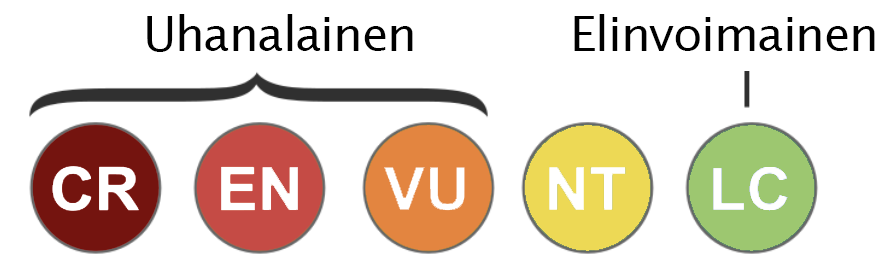
CR Critically endangered
EN Endangered
VU Endangered
NT Near threatened
LC Least concern
2019 VU - vulnerable
2015 VU - vulnerable
2010 LC - least concern
2000 LC - least concern
Regulations
EU Directive on Conservation of Wild Birds Annex II/A
EU Directive on Conservation of Wild Birds Annex III/B
Game bird (Hunting law 1993/615)
Safeguarding Endangered Species in Forestry – Lajiturva Project 2019–2021