

CONNECTIONS
Embracing complexity in sustainability
In education, everyday life unfolds through a variety of seemingly disconnected situations, making it challenging to grasp the holistic nature of sustainability. Without recognising the underlying interconnectedness of our activities, it becomes impossible to identify root causes or frame problems in a meaningful way.
Connecting different subjects and disciplines with sustainability helps construct an understanding of its entirety. It is also important to scrutinise how our individual contexts and cultural backgrounds shape the way we perceive sustainability and the knowledge we hold about it. Through regular participatory and transdisciplinary discussions, schools and universities can identify the most pressing sustainability challenges within their own environments. In addition, technical measurements can assist in identifying key causes of environmental impacts in school activities, enabling institutions to take appropriate action.
In educational practice, these competences emerge through understanding connections. Many practitioners experience everyday life in schools and universities as highly complex, with numerous connections to manage and a variety of issues to take care of – such as collaboration with stakeholders and other disciplines, curriculum content, disciplinary boundaries, and environmental concerns. This complexity can make promoting sustainability a challenging task.
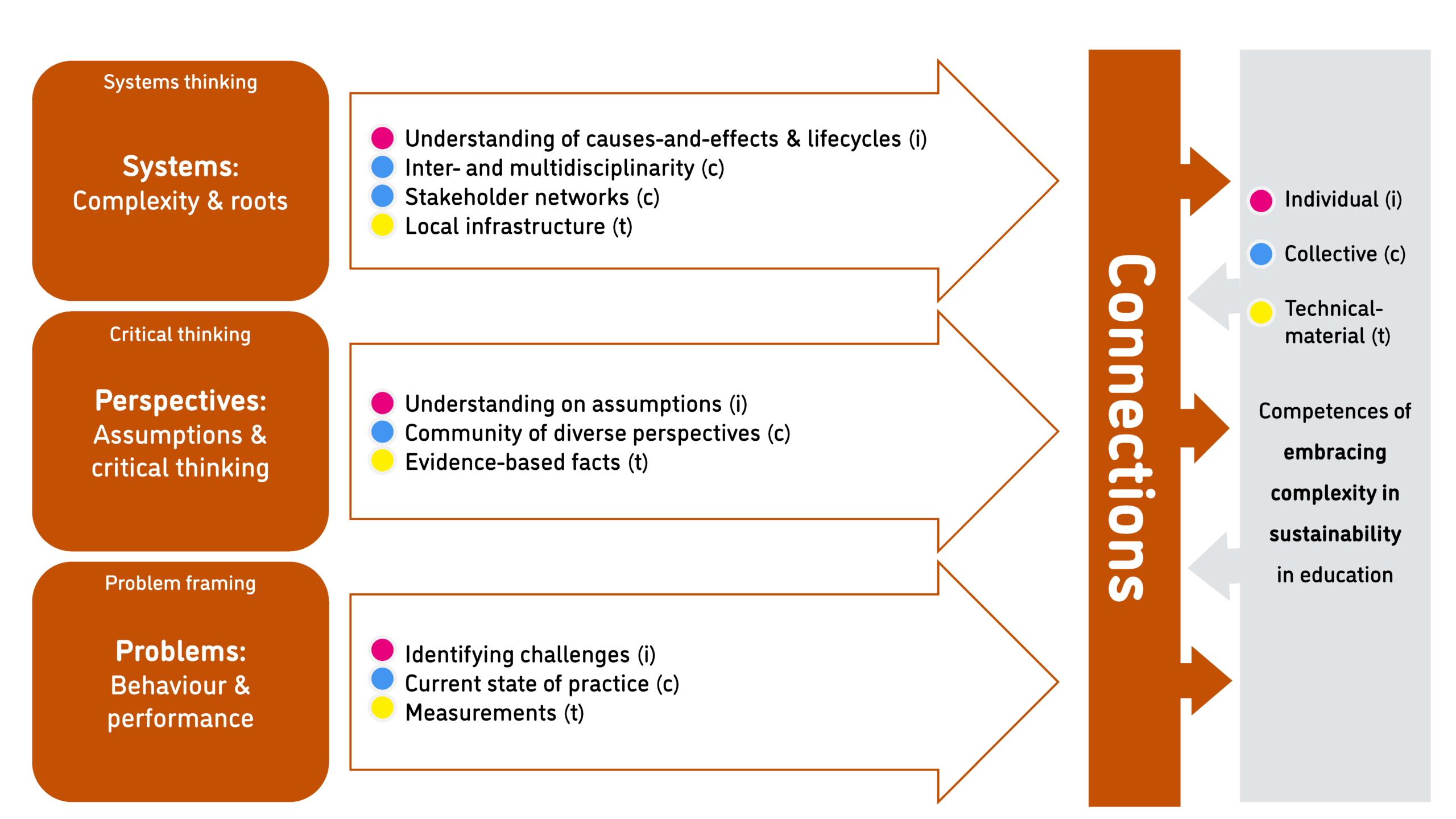





Systems: Exploring the complexity and roots of activities
Understanding cause-and-effect relationships and material life cycles enables students, teachers and administrators address key sustainability challenges. Inter- and multidisciplinary approaches reveal how different subjects and disciplines contribute to sustainability, supporting broad scientific, cultural, social and political perspectives. Mapping stakeholder networks and local infrastructure highlights key actors in sustainability efforts.
To approach a sustainability problem from all sides; to consider time, space and context in order to understand how elements interact within and between systems
- Equipping learners with systems thinking is necessary to understand complex sustainability problems and their evolution. Systems thinking allows us to understand reality in relation to other contexts (local, nation, global) and fields (environment, social, economic, cultural). It is critical for advancing sustainability. Thinking in systems enables learners to identify feedback mechanisms, intervention points and interactive trajectories.
- Systems thinking can be understood as a tool for evaluating options, decision-making and taking action. It is based on the assumption that parts of a system act differently when taken apart from the system.
- In fact, contrary to this, fragmentary thinking, i.e. analysing parts in isolation, instead of the whole interconnected system, increases short-termism and could led to an oversimplification of sustainability problems which may not correspond to reality.
Read more from the GreenComp document that EU have published and where the direct quotes of this GreenComp section are copied.
How to enable?
Knows that every human action has environmental, social, cultural and economic impacts.
Knows that human action influences outcomes across time and space, leading to positive, neutral or negative results.
Knows about life cycle thinking and its relevance for sustainable production and consumption.
Knows the main concepts and aspects of complex systems (synthesis, emergence, interconnectedness, feedback loops and cascade effects) and their implications for sustainability.
Knows the United Nations SDGs and is aware of interconnections and possible tensions between individual goals.
Skills
Can describe sustainability as a holistic concept that includes environmental, economic, social, and cultural issues.
Can assess interactions between environmental, economic, social, and cultural aspects of sustainability action, events and crises (e.g. migration caused by climate change or wars caused by resource scarcity).
Can assess how humans and nature interact across space and time.
Can use life cycle thinking to analyse the risks and benefits of human action.
Can identify in a system those challenges and opportunities that have the greatest potential to trigger change for sustainability.
Attitudes
Acknowledges the root causes of unsustainability for which humans are responsible, such as climate change.
Has a holistic grasp of connections and interactions between natural events and human actions.
Is concerned about the short- and long-term impacts of personal actions on others and the planet.
Cares about systemic consequences of environmental crises for current and future generations and for other species.
Is concerned about unpredictable cascade effects of human action.
- Critical analysis and mind maps of complex situations from diverse perspectives (environmental, social, economic, cultural, policies, networks) (c)

- Mapping the roles of actors in the system (agreements on responsibilities, including external stakeholders such as service providers, municipalities, NGOs) (c)
- Participatory audits with stakeholders to identify constraints and propose solutions (t)
- Tracking environmental impact (t)
- Life cycle studies (root causes, end result, rebound effects, post-school chain) on personal, community and cultural levels (i)
- Critical reflection to understand the connections to sustainability in and between different disciplines and subjects (i)


Creating or strengthening:
-
-
-
-
-
-
-
-
- (i)=individual competence
- (c)= collective competence
- (t)= technical-material competence
- (i)=individual competence
-
-
-
-
-
-
-
- Limited institutional support for the integration of environmental, economic and policy dimensions (c)
- Inconsistent engagement in community (c) and individually (i)
- Rigid academic structures (c)
- Fragmented curricula (c)
- Outsourcing services such as catering, cleaning and procurement, moving power from schools to external actors (c)
- Fragmented, insufficient and complicated decision structures, rules for action, and legislation (c)
- Infrastructural constraints (poor energy, food, waste management, transport services, municipality infrastructure) (t)
Creating or strengthening:
-
-
-
-
-
-
-
-
- (i)=individual competence
- (c)= collective competence
- (t)= technical-material competence
- (i)=individual competence
-
-
-
-
-
-
-
- How are different aspects of sustainability (e.g., waste, energy, procurements, equity) connected in your daily school life? Create a mind map.
- Who are the people and organisations involved in making your school more sustainable? How can we clarify and agree on responsibilities among staff, service providers and municipalities?
- What are the interconnections between environmental, social, economic, cultural and governance factors in our school’s sustainability practices?
- How do different subjects (e.g., science, history, arts) contribute to sustainability education?
- What is the life cycle of (a certain) procurement and equipment in your school?
Perspectives: Understanding assumptions and critically considering different viewpoints
Critically examining our individual and collective beliefs about how the Earth, people or societies function can reveal cultural biases that prevent us from recognising key sustainability factors. Tracking diverse perspectives within the educational community helps broaden our insights. A good way to avoid narrow-mindedness is to explore evidence-based facts – such as reviewing energy consumption data – or to gather stakeholder opinions through surveys and dialogues.
To assess information and arguments, identify assumptions, challenge the status quo, and reflect on how personal, social and cultural backgrounds influence thinking and conclusions.
- Critical thinking is considered fundamental for learners ‘to cope with uncertainty, complexity, and change’. Critical thinking is a high-level cognitive process, which includes several skills needed for evaluating and understanding information regarding sustainability problems. This enables learners to broaden their views without taking information and information sources for granted. Eventually, learners should be comfortable when acquiring and integrating information from different disciplines. A critical outlook allows learners to challenge, and change, their values, perspectives and understanding of the world.
- Critical thinking can help empower learners to become more responsible and actively cooperate in creating a sustainable world. More specifically, stepping up critical thinking will help them go beyond just passively understanding sustainability concepts. It will help them develop the ability to reflect and assess theories and assumptions.
Read more from the GreenComp document that EU have published and where the direct quotes of this GreenComp section are copied.
Knowledge
Knows that our understanding of sustainability is always evolving.
Knows that various biases can influence the discourse on sustainability, including reasoning, communication and political narratives.
Knows that predominant narratives can shape the formulation of sustainability problems.
Knows sustainability claims without robust evidence are often mere communication strategies, also known as greenwashing.
Knows that tackling unsustainable patterns requires challenging the status quo, at individual and collective level, by organisations and in politics.
Skills
Can apply personal reasoning to address criticism and arguments on sustainability matters.
Can analyse and assess arguments, ideas, actions and scenarios to determine whether they are in line with evidence and values in terms of sustainability.
Can scrutinise information sources and communication channels on sustainability to assess the quality of the information they provide.
Can reflect on the roots and motives of decisions, action and lifestyles to compare individual benefits and costs with societal benefits and costs.
Can look at various sources of evidence and assess their reliability to form opinions about sustainability.
Attitudes
Is curious and inquisitive about the links between the environment, human action and sustainability.
Trusts science even when lacking some of the knowledge required to fully understand scientific claims.
Takes an evidence-based perspective and is ready to revise it when new data emerge.
Is willing to accept and discuss sustainability questions, issues and opportunities.
Is sceptical about information on sustainability before verifying its source and investigating potential vested interests.
- Influencing attitudes, such as being open to change and seeing sustainability challenges in flexible ways (i)
- Looking at problems from different angles in participatory activities (c)
- Being critical when scrutinising technical-material practices and possibilities (t)
Creating or strengthening:
-
-
-
-
-
-
-
-
- (i)=individual competence
- (c)= collective competence
- (t)= technical-material competence
- (i)=individual competence
-
-
-
-
-
-
-
- Techno-optimism or pessimism constraining realistic plans (i)
- A high level of ‘meta-reflexivity’ is needed for structured reflection on cultural assumptions; no expert support for facilitators (c)
- Unexamined assumptions, like ‘students don’t care’ (i)
Creating or strengthening:
-
-
-
-
-
-
-
-
- (i)=individual competence
- (c)= collective competence
- (t)= technical-material competence
- (i)=individual competence
-
-
-
-
-
-
-
- What sustainability challenges do you notice in your school environment?
- What different viewpoints do different actors have about a sustainability issue chosen for inspection (like waste, energy, food)?
- What perspectives (e.g. cultural, economic) influence how people view sustainability?
- What current practices in our school might unintentionally hinder sustainability?
- Are we relying too much – or too little – on technology to solve sustainability problems?
- What cultural assumptions might influence how we teach sustainability?
Problems: Individual and collective behaviours and the environmental performance
Students, teachers, administrators and practices are all part of both the sustainability problem and the solution within schools and universities. Concerning individual and collective behaviours and the environmental performance, it is essential to identify and prioritise the most relevant challenges that can realistically be addressed. Participatory dialogues and scientific measurements, possibly supported by technical equipment, can assist institutions in this task.
To formulate current or potential challenges as a sustainability problem in terms of difficulty, people involved, time and geographical scope, in order to identify suitable approaches to anticipating and preventing problems, and to mitigating and adapting to already existing problems.
- Problem framing is the process of identifying actual or potential sustainability problems. It involves defining and structuring sustainability problems based on their complexity and those mainly involved. Understanding the nature of the actual or potential problems we are trying to define, e.g. from simple to wicked problems, can be a major obstacle.
- Most fundamentally, problem framing defines what is challenging about a given situation and identifies the best action to address it, which involves systems thinking. In essence, problem framing helps define goals and the direction the problem solving process should take. While sustainability problems are complex and often cannot be solved, appropriate steps can be taken either to anticipate and prevent them, or to mitigate and adapt them to an already
existing problem. - Problem framing can help identify situations and frame them as current or potential problems for sustainability in a given context. This requires a critical understanding of socioecological systems. In turn, problem framing can help contextualise and define a sustainability problem in a given geographical and temporal context.
Knowledge
Knows that sustainability problems are often complex and that some cannot be solved entirely.
Knows that measures and action to address a sustainability problem depend on how the problem is framed (by/with/for whom, where, when, why).
Knows that to identify fair and inclusive actions, it is necessary to look at sustainability problems from different stakeholder perspectives.
Knows that sustainability issues range from relatively simple to complex problems and that establishing their type helps find suitable approaches.
Knows that current or potential sustainability problems can quickly evolve and therefore need to be frequently redefined and reframed.
Skills
Can factor in perspectives of multiple stakeholders, considering all life forms and the environment to frame current and potential sustainability challenges.
Can apply a flexible, systemic, life cycle and adaptive approach when framing current and potential sustainability challenges.
Can establish a transdisciplinary approach to framing current and potential sustainability challenges.
Can continuously explore the problematics of a sustainability issue to broaden the range of alternatives and solutions.
Can identify appropriate approaches to mitigate, adapt and potentially solve sustainability problems.
Attitudes
Is committed to presenting a sustainability problem as a complex one rather than oversimplifying it.
Tries to detach one’s own judgement from the process of framing the problem.
Listens actively and shows empathy when collaborating with others to frame current and potential sustainability challenges.
Shows empathy with all life forms.
- Mapping individual and contextual unsustainable behaviours and sustainability problems in everyday life (c)
- Regular assessments of environmental, social and economic systems (data on electricity and water consumption, air quality, waste, individual pro-environmental behaviour) (t)
- Framing priority problems, e.g. by using baseline KPIs to find enablers and opportunities that have the greatest potential: pinpointed leverage points (t)
- Acquiring knowledge about possible solutions and the impact of potential changes and facts to avoid relying too much or too little on technical solutions (i)
- Allocating sufficient financial resources, including systematic and regular monitoring and revision of equipment (c)
- Using AT and digital platforms (energy-use curves, water-flow graphs and CO₂ levels) to help observe the effects of actions and to set reduction goals (t)(i)
- Using storytelling, peer modelling and persuasive communication to spread practices beyond core groups (i)
Creating or strengthening:
-
-
-
-
-
-
-
-
- (i)=individual competence
- (c)= collective competence
- (t)= technical-material competence
- (i)=individual competence
-
-
-
-
-
-
-
- Simplistic framings of the problem (i)
- Individual, collective and technical-material factors that reduce motivation to participate in environmental activities (i)(c)(t)
- Poor local infrastructure, e.g. insufficient or poorly placed bins and unclear signage (t)
- Interventions requiring the installation of equipment or devices: no provisions made for repair and maintenance, lack of on-site maintenance skills (i)(c)(t)
- Challenges of assessing the environmental benefits of classroom content and debates (c)
- Missing skills and knowledge for the assessment of environmental performance (i)(t)
- Budgetary limitations (c)
Creating or strengthening:
-
-
-
-
-
-
-
-
- (i)=individual competence
- (c)= collective competence
- (t)= technical-material competence
- (i)=individual competence
-
-
-
-
-
-
-
- What are the sustainability challenges in this context? What are the most impactful changes to be made in our institution with limited resources?
- How can we improve our skills in evaluating environmental performance?
- What knowledge or data can be collected to critically assess sustainability in our school or university?
- How to make environmental data visible and meaningful for students?
- How to ensure that sustainability equipment is maintained and monitored effectively, and how can we allocate resources for repairs and upkeep?
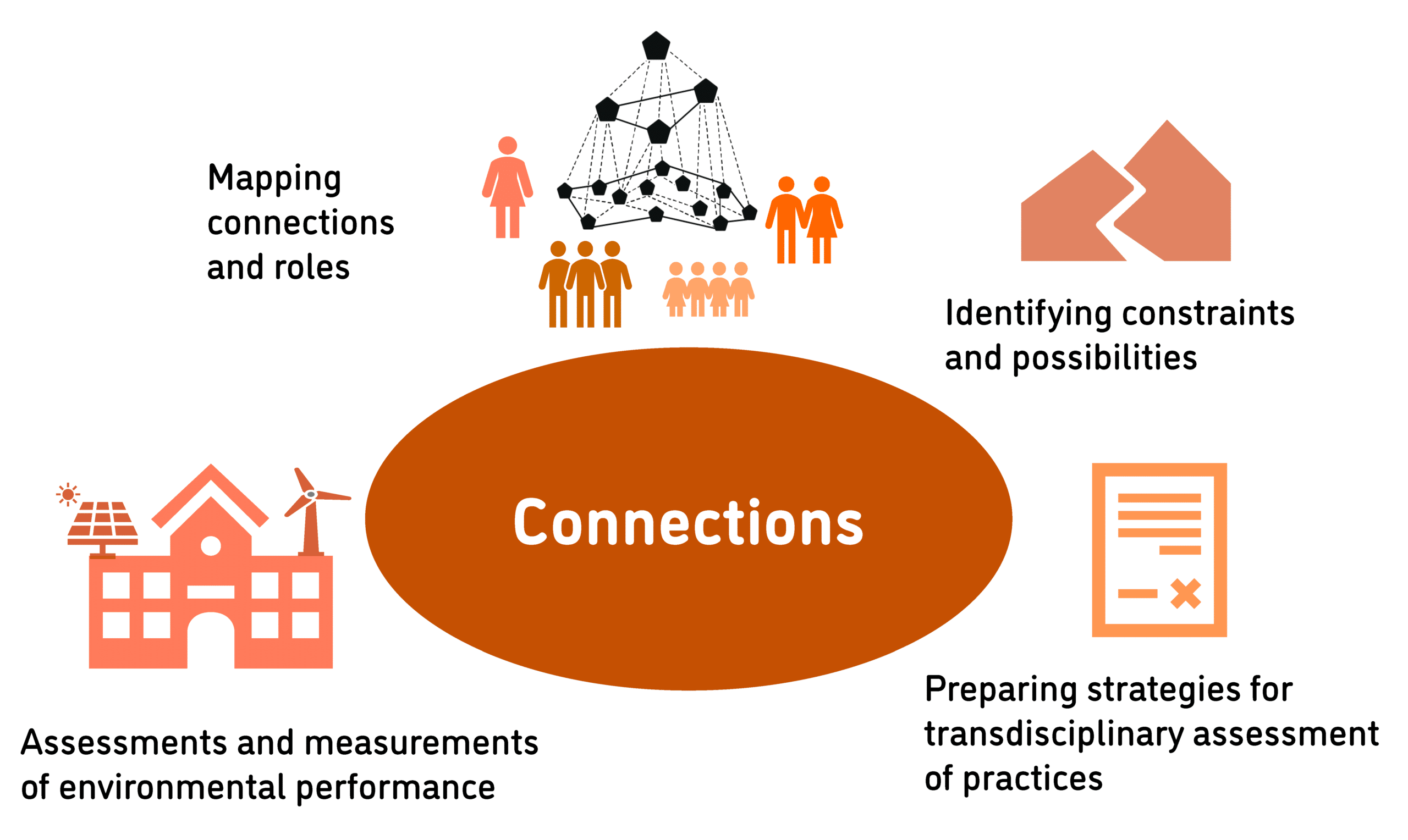
Mapping connections and roles, identifying constraints and possibilities, preparing strategies for transdisciplinary assessment of practices and assessments and measurements of environmental performance enable understanding of connections.
Stories about Connections from the ECF4CLIM project schools and universities
-

Planning a multidisciplinary Sustainability Transitions Study Module at the University of Jyväskylä
Read moreAt the University of Jyväskylä, Finland, ECF4CLIM supported the interdisciplinary collaborative development process of ‘Basic Multidisciplinary Studies in Sustainability Transitions’ study module. It introduces students to the needs, barriers and opportunities of sustainability transitions from a multidisciplinary perspective of technological solutions, social governance systems, cultures, and behaviours. The interdisciplinary planning proved fruitful, but challenging.
-
Different cross-curricular approaches in Romania and Spain
Read moreAt the University of Pitești, engineering students applied sustainability principles in technical projects supported by a co-designed curriculum.
At UAB (Spain), one of the interventions was the design and implementation of an open two-credit course on critical analysis of the eco-social crisis, available for students from any study programme offered by the university.
-
Understanding connections when improving the sustainability of school meals in Finland
Read moreImproving the quality and sustainability of school meals served in schools was considered the most relevant issue among students and personnel of both demonstration sites located in Tampere, Finland. Also, fostering positive attitudes towards vegetarian food was another common goal for the interventions in both schools. These issues are very relevant as schools have a key role in sustainable food transitions, especially in Finland, where there is a long tradition of free school meals.
-
Changing things by changing things (CO2 and water market)
Read moreIn CEIP Mozart, students, teachers and parents engaged in the organisation of a local market within the school community for the exchange of good-condition T-shirts. They could calculate the CO₂ and water savings associated with wearing a second-hand T-shirt using a weighing scale and a carbon and water footprint calculator (taking into account the weight and type of textile).
-
Understanding connections in Portugal and cross-sectoral collaboration
Read moreIn Portugal, the ECF4CLIM interventions helped to strengthen connections between schools, universities, municipalities and local communities. Collaboration between the Instituto Superior Técnico (IST) and EB Camarate created a two-way exchange of knowledge: university researchers and students provided technical and scientific support, while the school offered real contexts for collaborative sustainability learning.
-
Collected short examples from all countries
Lue lisääThere were many examples of cooperation with stakeholders from outside of the school, as these stakeholders are often necessary for the proper functioning of the school itself.

Connections and competences
The main viewpoints in understanding connections are systems, perspectives, and problems, as described above. Different spheres of sustainability competence can contribute to understanding connections:
- Facilitating individual students, teachers, headmasters, or other staff members to learn systemic and critical thinking and problem framing;
- Focusing on understanding networks and collective regulations, norms, practices and organisational culture to figure out the relevant connections; and
- Developing the technical-material environment to have the equipment to provide evidence and measure the current state of practice.
The individual, collective and technical-material possibilities are intertwined, with each area enabled by the other two.
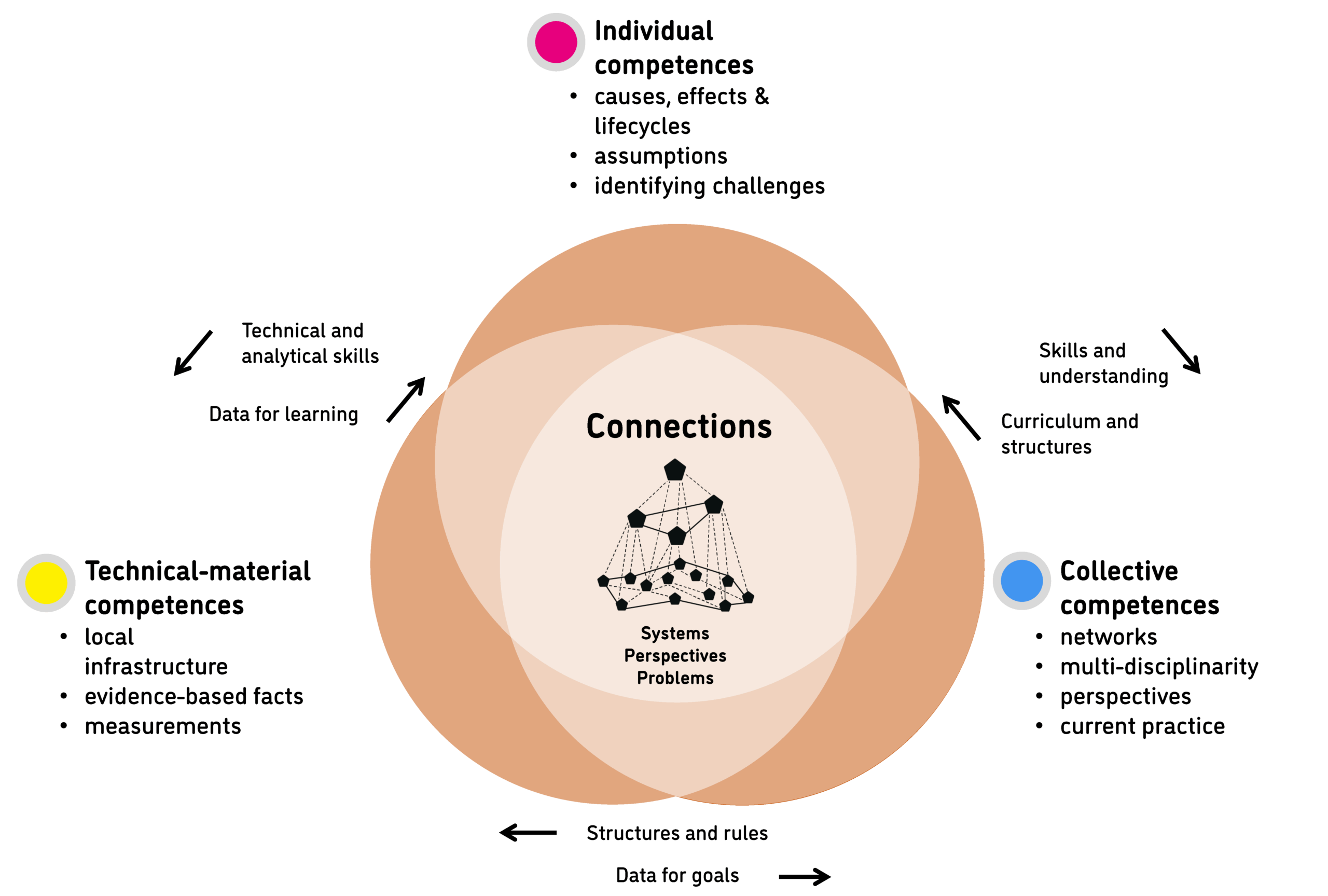
Understanding causes and effects, life cycles, and underlying assumptions require individual competences
Systems knowledge, creative out-of-the-box thinking, and analytical skills are required when identifying challenges. Positive attitudes toward reflecting on personal and cultural worldviews are also essential. Awareness of relevant actors and diverse perspectives – such as disciplinary, cultural, technical, environmental, social and political – is necessary, along with an understanding of how these elements are interconnected. These competences are important for all actors in educational settings. Participants in diverse networks working toward sustainability efforts benefit from cooperation skills, commitment to transdisciplinary work, and social influence competences. Leaders can gain advantage from project management competences when guiding collaborative groups that promote sustainability. In this complex system, the ability to accept the complexity of the world is vital.
Structures and networks for cooperation are essential collective competences in navigating interconnected systems
Regulations and norms that maintain or advance sustainable practices are notable competences for promoting sustainability. An organisational culture that brings diverse perspectives to the forefront helps construct sustainability in schools and universities. Sustainability is supported by curricula that integrate sustainability perspectives across all subjects and disciplines, as well as by multidisciplinary practices that draw connections between them. A collective understanding of the key factors behind unsustainability is valuable in sustainability efforts.
Technical-material competences enable schools and universities to gain access to evidence-based facts
Evidence-based facts can be gained, for example, through measurements of water and energy consumption or the amount of waste. This data can evolve into new technical-material competences when it highlights the need for new procurements that reduce environmental impact. Local infrastructure constitutes an essential part of technical-material competence: for instance, functioning energy, transport and waste collection systems in the municipality are crucial for the local operations of schools and universities.
Individual, collective and technical-material competences related to connections are deeply intertwined
For example, when developing strategies and cooperation plans for sustainability, individual competences in collaboration and management are essential. In turn, a curriculum that includes sustainability as a norm can guide individual teachers to address environmental or social issues and facilitate multidisciplinary teamwork in their lessons.
Many improvements in the technical-material environment require collective competences, such as communication structures across organisations and established practices and rules for procurement. Additionally, an organisational culture that promotes sustainability can lead to enhancements in material-technical infrastructure.
Technical-material competences can generate data that individuals use to build knowledge on sustainability. Conversely, individual competences – such as technical skills and the ability to analyse and interpret data – are needed to install and maintain technical infrastructure and to utilise data from technical equipment.