
-

White Wagtail – Motacilla alba
Ómar Runólfsson, White Wagtail – Motacilla alba – Maríuerla. Creative Commons BY-NC-SA-2.0
Ómar Runólfsson, Creative Commons Attribution Noncommercial Share-Alike 2.0
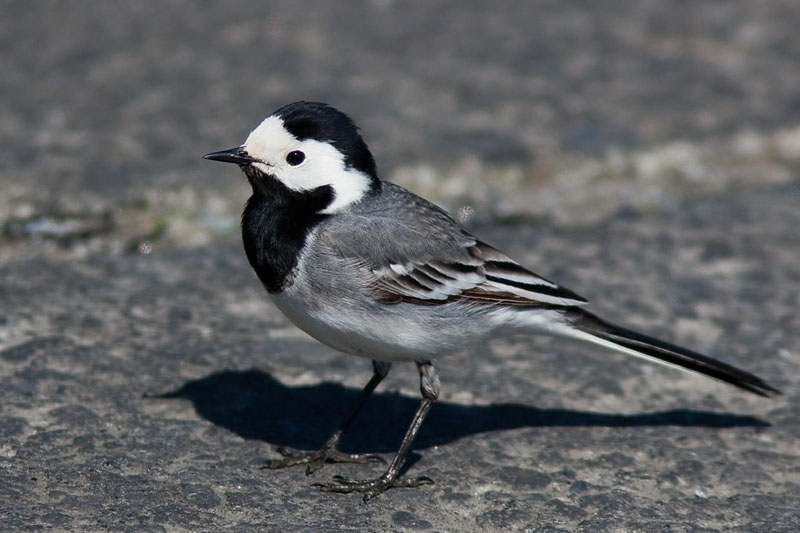
White Wagtail
(fi: västäräkki, sv: sädesärla)
Motacilla alba
The tiny dancer of the open air, dressed in elegant black, white, and soft grey
Identification
Easily recognized by its striking black, white, and grey plumage, the White Wagtail has a crisp white face, a black throat and bib, and grey wings. Its long, narrow tail is almost always in motion, rhythmically wagging up and down, a distinctive behavior that gives the bird its name.
Habitat
The White Wagtail is often seen walking or lightly running along the ground rather than hopping, moving with quick, graceful steps. It thrives near water, rivers, lakes, and wetlands but is equally at home in open fields and urban areas.
Nutrition
The White Wagtail is insectivorous, actively searching for small invertebrates and insects directly on meadows in the low grass, even near watercourses.
Breeding
Mating occurs between April and August. The nest, a cup of grass finished with wool, hair and feathers, is hidden in natural and artificial crevices but also on the ground.
Migration
The White Wagtail is resistant to the most disparate climates: from the rigid temperatures of Siberia to the scorching temperatures of Saudi Arabia. Most of the White Wagtails living in Finland migrate to the northern Africa and the Middle East.
Distribution
The White Wagtail breeds throughout most of Europe, from the Iberian Peninsula and the United Kingdom, across central countries such as France, Germany, and Italy, and extending far into Scandinavia and Eastern Europe.
Status and conservation
IUCN assessment of this species is Least concern (LC) in the Red List categories. The species is protected by the Birds Habitats Directive.
Cultural heritage
Across many parts of Europe, the White Wagtail is associated with the arrival of spring and the renewal of life. In several Northern and Eastern European folk traditions, wagtails are linked to movement, change, and the flow of time.
Explore the factors affecting the species
Organism groups
Endangered status in Finland
ENDANGERED CATEGORY (International Union for Conservation of Nature (IUCN) classification)
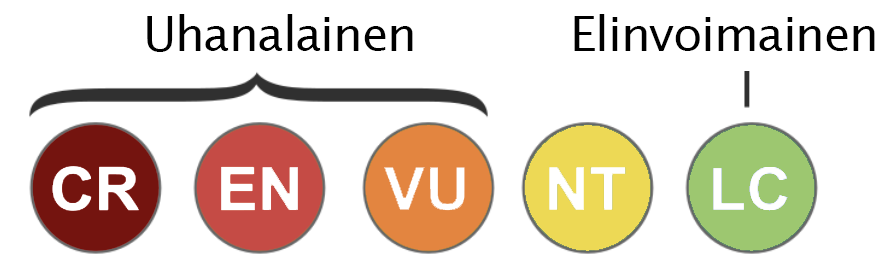
CR Critically endangered
EN Endangered
VU Endangered
NT Near threatened
LC Least concern
2019 NT - near threatened
2015 LC - least concern
2010 LC - least concern
2000 LC - least concern
Regulations
No regulations.