
-

Sparrowhawks have a grey back and males often show a distinctive reddish breast.
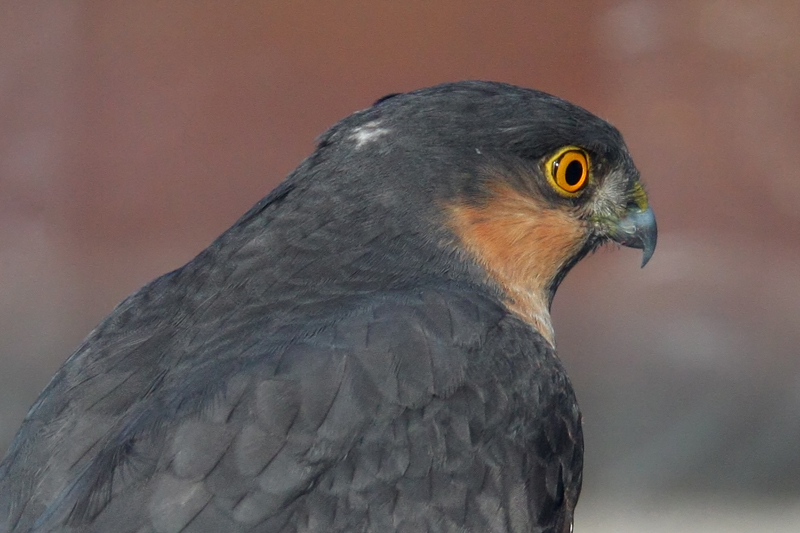
Eurasian Sparrowhawk
(fi: varpushaukka, sv: sparvhök)
Accipiter nisus
An agile bird of prey that hunts other birds, sometimes as large as itself.
Identification
A small raptor, clearly smaller than a crow. It has thin legs, a long tail and short, rounded wings. Adults have a grey back and finely barred underparts, while juveniles are browner. Males often show a distinctive reddish breast.
Habitat
Prefers dense mixed forests, young woodlands and forest edges, but can also be found in parks, gardens and other wooded areas near human settlements. It hunts in both forests and open countryside.
Distribution
Widespread across Europe and much of Asia. Found throughout Finland, including Lapland, and common in Slovenia, Romania and Italy.
Nutrition
Feeds mainly on birds, ranging from small songbirds to species as large as woodpeckers, blackbirds and pigeons. It is a stealth hunter, relying on speed, agility and surprise attacks.
Breeding
Builds a new nest each year, usually in a tree, often a spruce. The nest is well concealed, and the species remains secretive around its breeding site.
Migration
A partial migrant. Many northern birds migrate south for winter, while some remain year-round. Climate change has advanced both spring and autumn migration, with increasing numbers leaving northern Europe earlier in the season.
Status and conservation
Globally classified as Least Concern (LC). Like many birds of prey, the sparrowhawk suffered from pesticides such as DDT during the twentieth century. Conservation measures and bans on harmful chemicals have helped populations recover across much of Europe.
Cultural heritage
In European traditions, hawks symbolize speed, sharp eyesight and hunting skill. In Finland, hawks were often compared to eagles and believed to possess supernatural powers that could protect livestock and property. The species also has a long history in falconry and appears in proverbs, folklore and place names across Europe.
Explore the factors affecting the species
Organism groups
Endangered status in Finland
ENDANGERED CATEGORY (International Union for Conservation of Nature (IUCN) classification)
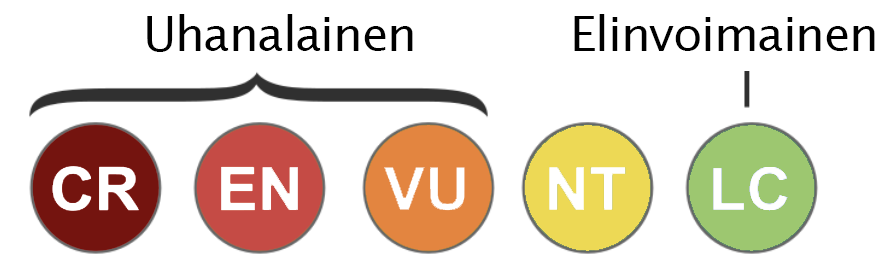
CR Critically endangered
EN Endangered
VU Endangered
NT Near threatened
LC Least concern
2019 LC - least concern
2015 LC - least concern
2010 LC - least concern
2000 LC - least concern
Regulations
Convention on International Trade in Endangered Species of Wild Flora and Fauna - CITES, Appendix II
EU regulation regarding CITES, Appendix A
Regionally Threatened 2020 - 4c Northern boreal, Forest Lapland
Regional assessment of threatened species 2020 has been carried out in a national assessment for species of bryophytes, vascular plants, fungi, lichens, butterflies and moths and birds classified as Least Concern (LC) and Near Threatened (NT). Species assessed as being regionally threatened are classified as RT (Regionally Threatened).