
-

House Sparrow – Passer domesticus
Luciano Giussani, Moineau domestique – Passer domesticus – House Sparrow. Creative Commons BY-NC-SA-2.0
Luciano Giussani, Creative Commons Attribution Noncommercial Share-Alike 2.0

House Sparrow
(fi: varpunen, sv: gråsparv)
Passer domesticus
A bird found in towns and villages that has vanished from many places in Finland.
Identification
A small grey-brown bird with a sturdy beak. The back is brown and streaked, the belly and crown are grey. The male has a black eye patch and throat patch, with a reddish-brown stripe behind the eye. The female lacks the black markings. Listen to the sparrow’s call by clicking the button above.
Habitat
The house sparrow lives close to humans. It nests in cities, towns, and farms. Barns are particularly favourable for sparrows, but they can also nest at gas stations and parks. Sparrows usually nest in building crevices, rarely in birdhouses.
Distribution
Widespread throughout Europe and globally. In Italy habits only some border areas on the Alps.
Nutrition
The sparrow feeds on seeds and invertebrates. Also visits bird feeders. Parents feed their chicks with insect larvae.
Breeding
Closely associated with human habitation. Breeds very commonly around farmyards, in towns and villages. Nests under roof tiles, in holes and cavities. May also build nests in open site.
Migration
Resident bird. Young individuals may search for breeding sites further away.
Status and conservation
Globally Least concern (LC). The population trend in Europe is considered slightly decreasing. Endangered (EN) in Finland, the breeding population has declined sharply since the 1980s. The reason is at least partly due to changes in agriculture.
Cultural heritage
The house sparrow has a rich presence in cultural heritage in many of the European countries. In Finnish culture it was regarded as the soul bird of children. In some countries the house sparrow was often considered an ominous bird. Reed more from the booklet.
Explore the factors affecting the species
Organism groups
Endangered status in Finland
ENDANGERED CATEGORY (International Union for Conservation of Nature (IUCN) classification)
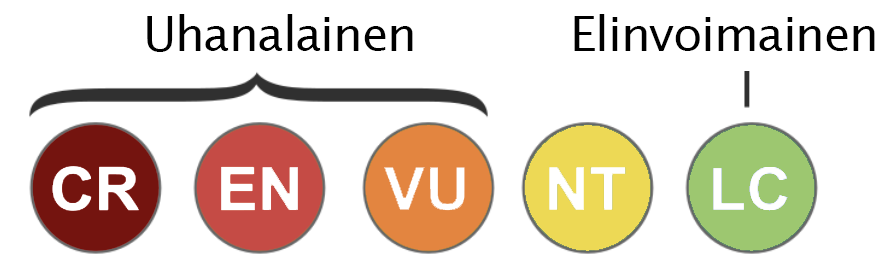
CR Critically endangered
EN Endangered
VU Endangered
NT Near threatened
LC Least concern
2019 EN - endangered
2015 VU - vulnerable
2010 LC - least concern
2000 NT - near threatened
Regulations
Threatened species (NCD 2023/1066, Appendix 6)
The Nature Conservation Decree can regulate a wild species whose natural survival in Finland has been endangered as an endangered species.
Environmental changes and species ecology
Factors that affect the abundance and/or behavior of the species.