
-

Eurasian Blue Tit – Cyanistes caeruleus
Mikko Karvonen, Song of a Blue Tit. Creative Commons BY-NC-2.0
Mikko Karvonen, Creative Commons Attribution Noncommercial 2.0

Eurasian Blue Tit
(fi: sinitiainen, sv: blåmes)
Cyanistes caeruleus
A small, colorful songbird of the gardens and parks but also of the mature forest
Identification
It has a bright blue crown, wings, and tail, contrasted with a yellow chest and a greenish back. Its face is white with a distinctive dark blue line running through the eyes. The yellow of juveniles is much more vivid than that of adults.
Habitat
The Blue Tit is a species typically associated with tall, wooded environments with mature trees (which guarantee the presence of cavities suitable for nesting), mainly oaks and chestnut trees, but it can also be found in woods consisting of other broad-leaved trees, coniferous woods, parks and urban gardens.
Nutrition
The Blue Tit feeds mainly on insects and caterpillars, playing an important role in keeping trees healthy, but in colder months it happily visits feeders for seeds and nuts.
Breeding
The Blue Tit typically nests in tree holes or nest boxes. The species is known for being curious and adaptable, thriving even in urban parks and gardens. It also uses holes in dry stone walls and buildings.
Migration
It is a sedentary species, although most individuals that breed in the central-northern sectors of its vast breeding range make irregular irruptive movements, mainly southwards and westwards.
Distribution
The Blue Tit breeds uniformly from the Canary Islands and North Africa to central Scandinavia, reaching, towards the south-east, the Caucasus and northern Iraq. In Europe it is only absent from Iceland and the northernmost latitudes.
Status and conservation
The species has a favorable conservation status in Italy and at continental level.
Cultural heritage
The Blue Tit appears in various European cultural traditions, often symbolizing joy, vitality, and the return of spring.
Explore the factors affecting the species
Organism groups
Endangered status in Finland
ENDANGERED CATEGORY (International Union for Conservation of Nature (IUCN) classification)
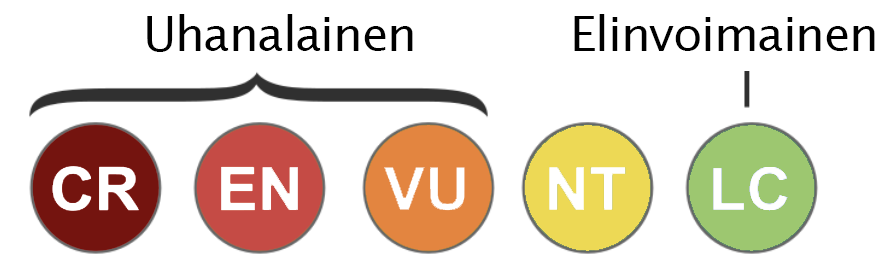
CR Critically endangered
EN Endangered
VU Endangered
NT Near threatened
LC Least concern
2019 LC - least concern
2015 LC - least concern
2010 LC - least concern
2000 LC - least concern
Regulations
No regulations.