

CHANGE
Envisioning sustainable futures
Amid the current deepening ecological and sustainability crises, educating future generations to take responsibility for change is a complex task – especially when no one has precise knowledge of the solutions. In schools and universities, collective discussions and decisions based on scientific future scenarios are essential for identifying the most effective paths toward sustainability. Once the collective and technical-material conditions and possibilities within a specific institution are understood, meaningful and achievable goals can be defined through creativity, adaptability and a willingness to learn things that do not yet even exist.
In educational practice, these competences are expressed through addressing change in schools and universities. For practitioners, it is often easier to focus on concrete ways to improve sustainability and reduce environmental impact within their own institutions, rather than relying on abstract visions. They are interested in what concrete options are available to them and what specific changes are needed. Uncertainty and eco-anxiety can make the process burdensome.
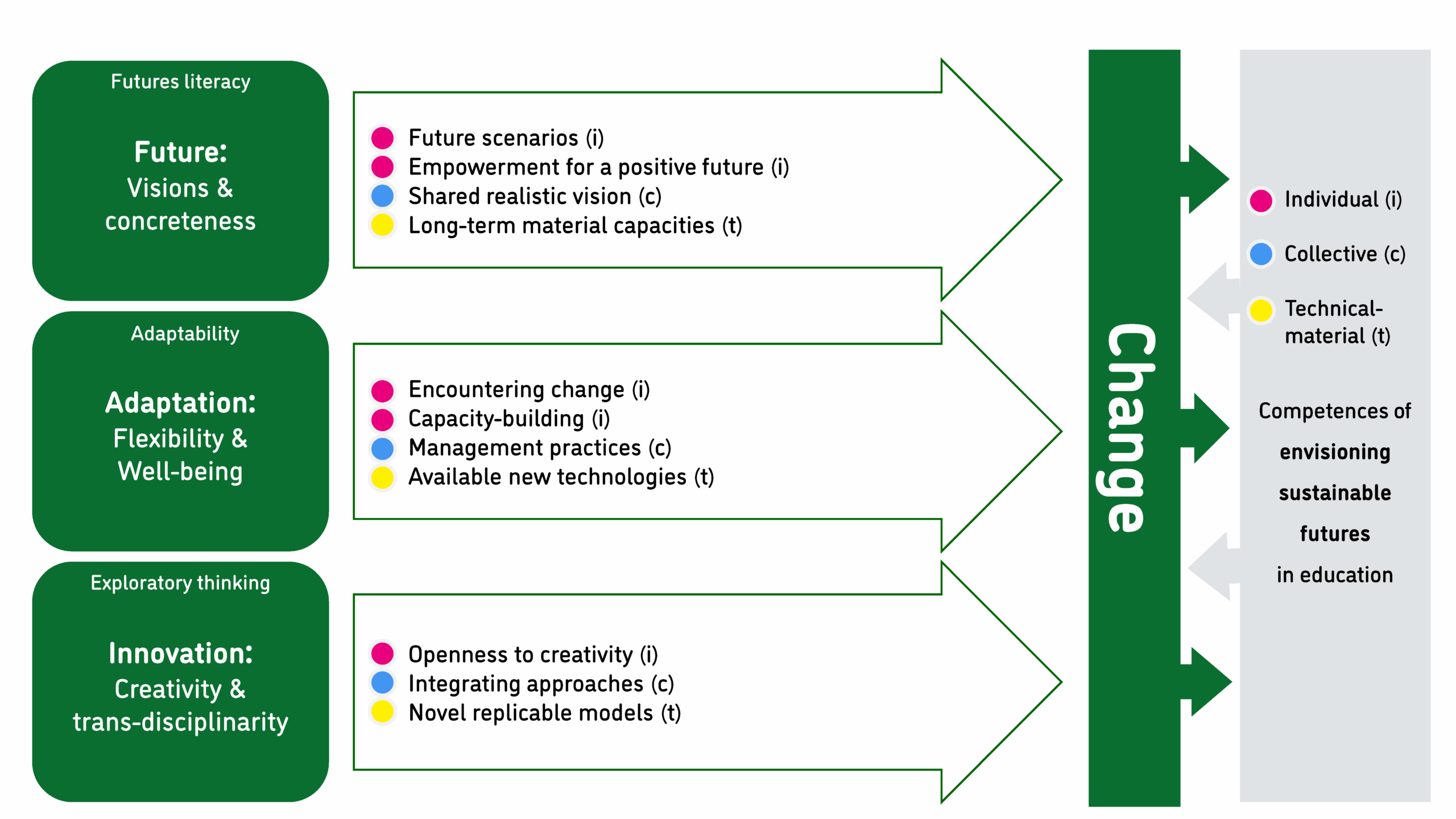




Future unfolds through visions and concreteness
Outlining possible future visions and how they can be translated into concrete goals within the school or university is important. Studying undesirable, probable and preferable futures can sometimes lead students and even adults to apathy and despair, so it is important to empower the community with belief in the possibility of a sustainable future. Designing a shared, realistic vision of the steps the institution can take helps the vision of the preferred future to become concrete. If the institution decides to improve its technical-material capacities, it is also important to consider long-term procurement and to think critically about future maintenance, durability and the life cycle of the equipment.
To envision alternative sustainable futures by imagining and developing alternative scenarios and identifying the steps needed to achieve a preferred sustainable future.
- Futures literacy empowers learners to create their visions for a sustainable future by providing them with the knowledge, skills and attitudes to understand the futures as a variety of alternatives. Research commonly differentiates between three approaches in order to understand the futures:
- expected future, i.e. what we expect to happen based on what it is happening today and what we know, e.g. business as usual;
- alternative future(s), i.e. what will happen may differ from expectations, e.g. creation of green jobs that currently do not exist;
- preferred future, i.e. we may envision a sustainable future for us, our community and our planet, and identify the steps and actions needed to achieve that future, e.g. a circular economy.
- Through futures literacy, learners can anticipate, prepare and invent as changes occur55. Futures literacy encourages learners to i) use their imagination when thinking about the future, ii) tap into their intuitions and creativity, and iii) assess the possible steps needed to achieve their preferred future. By using real-life experiences, learners can be taught in futures methodologies that adopt qualitative and/or quantitative research methods.
Knowledge
Knows the difference between expected, preferred and alternative futures for sustainability scenarios.
Knows the difference between short , medium and long term approaches and their implications for sustainability scenarios.
Knows that scenario development can factor in past events and current signals of change.
Knows that scenarios can inform decision making for a desired sustainable future.
Knows that effects caused by humans play a major role when mapping alternative and preferred future scenarios.
Skills
Can envisage alternative futures for sustainability that are grounded in science, creativity and values for sustainability.
Can analyse and evaluate futures and their opportunities, limitations and risks.
Can identify action and initiatives that lead to a preferred future.
Can anticipate future implications by looking at past trends and present conditions.
Attitudes
Has a long-term perspective when planning, assessing and evaluating sustainability actions.
Is concerned about the impact of one’s own action on the future.
Is aware that the projected consequences on self and community may influence preferences for certain scenarios above others.
Seeks to combine rigorous methods for thinking about the future with creative and participatory approaches.
- Using simple planning exercises – like basic future-scenario sessions and working backwards from key goals (c)

- Empowering students to take on the role of community ambassadors and believing that they could shape the future(c)
- Hands-on activities to try out new tools and think about reusing materials can turn big sustainability ideas into small, projects of change that give hope and help the school learn and grow(c)
- Critical reflection on how to realise the visions of a sustainable future in one’s own life and in the community(i)
- Vision promoted by leaders who prioritise sustainability in their daily decision-making processes and encourage everyone to envisage preferred and feasible futures (i)
- From ambition to action by testing plans against real-world constraints (i)
- Strengthening institutional material capacities, while empowering school communities to manage and maintain sustainable infrastructures over the long term (t)
- Easy‐to‐update equipment makes it easier to keep long‐term plans realistic and flexible(t)


Creating or strengthening:
-
-
-
-
-
-
-
-
- (i)=individual competence
- (c)= collective competence
- (t)= technical-material competence
- (i)=individual competence
-
-
-
-
-
-
-
- Lack of understanding the meaning and value of visioning (i)
- Indifferent leadership and fragmented communication result in hesitation and cynicism among students, who then doubt the impact of their efforts (i)
- Contradiction between what is recommended at school and the dynamics that govern today’s consumer society(c)
- Demands for a less consumerist future remain vague, as it is difficult to imagine such a future in the current context (c) (i)
Creating or strengthening:
-
-
-
-
-
-
-
-
- (i)=individual competence
- (c)= collective competence
- (t)= technical-material competence
- (i)=individual competence
-
-
-
-
-
-
-
- How can we integrate sustainability into our daily decision making and long-term planning?
- How can we empower students to take leadership roles in sustainability efforts within the school and the wider community?
- Are our current strategies and resource allocations aligned with our sustainability goals? If not, what needs to change?
- How can I incorporate hands-on, hopeful sustainability projects into my teaching to make abstract ideas tangible?
- How can I support students in navigating the contradictions between sustainability education and consumer culture?
- How do I feel when thinking about the future, and how can I turn those feelings into motivation for change?
Adaptation: Being flexible in the face of change without compromising well-being
Encountering change is always a personally burdensome experience, even when it leads to a better future. The school or university can support the entire community – including students, teachers and maintenance staff – by providing opportunities to build their capacities and avoiding know-how gaps through learning. Management practices play a crucial role in the adaptation process and steering the development of concrete, shared, preferably written action plans. Possible new technologies require flexibility from the whole community: maintaining a critical attitude, accepting uncertainty, and believing in the power of learning.
To manage transitions and challenges in complex sustainability situations and make decisions related to the future in the face of uncertainty, ambiguity and risk.
- Adaptability is about being flexible and able to adapt to new situations and adjust in order to accommodate changes in our complex world. It is essential that learners be able to cope with uncertainty
about the future and the ambiguity of wicked sustainability problems and how they may evolve. Adaptability should provide learners with the ability to cope with trade-offs in sustainability e.g. environmental impacts and social outcomes as well as economic aspects. Moreover, learners should feel empowered to consider options and make decisions even when facing contradictions and risks in terms of the future. - People can learn in order to acquire knowledge, which may result in them changing their opinions and behaviour, and learning to manage their emotions. For cognitive adaptability, this might involve better teaching people about the significance of a changing climate. For behavioural adaptability, this might involve promoting positive and constructive actions among young people that support and sustain the environment, such as saving energy, recycling, harnessing clean energy, controlling water use, and encouraging others at home and at school to do the same things.
Knowledge
Knows that human actions may have unpredictable, uncertain and complex consequences on the environment.
Knows that there is no single solution to complex socioecological problems, but rather different alternatives depending on time and context.
Knows about risks associated with transformations of the natural environment by humans.
Knows which aspects of personal lifestyle have higher impacts on sustainability and require adapting (e.g. air travel, car usage, meat consumption, fast fashion).
Knows the importance of the link between local impacts and global sustainability.
Skills
Can adapt to different approaches when working on sustainability.
Can identify and adapt to different lifestyles and consumption patterns to use fewer natural resources.
Can take into account local circumstances when dealing with sustainability issues and opportunities.
Can navigate the ambiguity and uncertainty around sustainability issues while thinking about alternatives.
Attitudes
Acknowledges the emotional impact of climate change, loss of biodiversity and impoverishment.
Is willing to discontinue unsustainable practices and try alternative solutions.
Is comfortable considering sustainable options, even if competing with personal interests.
Is flexible, resourceful and adaptable in coping with unexpected environmental changes.
Copes with trade-offs in decisions on sustainability within and across domains (environmental, social, economic, cultural, political) and across time and space.
- Boundary-spanning leadership, uniting students, staff, parents and authorities (i)
- Capacity-building culture broadening the circle of vision carriers: Caretakers are trained in waste handling, technicians in sensor maintenance, and teachers in new pedagogical approaches -> opportunities for growth (c)
- Deliberative workshops foster a climate conducive to the expression of emotions and creativity. Deliberations allowing for collective diagnoses and the development of creative proposals (c)
- Keeping long-term plans realistic and flexible (c)
- Assimilating novel technologies or approaches, flexibility in adopting unknown tools (e.g. sensors, applications, innovative materials) (t)
- Purchasing easy-to‐update equipment (t)
Creating or strengthening:
-
-
-
-
-
-
-
-
- (i)=individual competence
- (c)= collective competence
- (t)= technical-material competence
- (i)=individual competence
-
-
-
-
-
-
-
- Denial of personal responsibility and relevance, and narrow ownership (i)
- Creativity blocks (i)
- When people see actions as unimportant, interest fades quickly (i)
- Lack of financial resources and time (c)
- The hierarchical relationships typical of schools and universities seldom allow the opportunity for students to express themselves and teachers to be heard (c)
- Inconsistencies between what is taught about sustainability and the actual practices within the educational institutions (c)
Creating or strengthening:
-
-
-
-
-
-
-
-
- (i)=individual competence
- (c)= collective competence
- (t)= technical-material competence
- (i)=individual competence
-
-
-
-
-
-
-
- How do our management practices support emotional well-being and creativity during times of change?
- How can I support students in adapting to change while maintaining their emotional well-being?
- What kinds of opportunities are we providing for students and staff to express themselves and contribute meaningfully to sustainability efforts?
- What strategies can we use to overcome hierarchical barriers and promote inclusive leadership across the school community?
- How can we ensure that new technologies and equipment are easy to update and maintain over time?
Innovation grows from creativity and transdisciplinarity
Creatively designing novel solutions by leveraging transdisciplinary networks as a strength is useful. Sustainability challenges cannot be addressed using the old means. Personal openness to creativity and new solutions is essential. In this work, both internal and external cooperation are vital, as transdisciplinary insights can lead to the creation of something truly novel. Ideally, the school or university can innovate replicable models that can be shared beyond the institution. A prerequisite for innovation is critical assessment of the need for change.
To adopt a relational way of thinking by exploring and linking different disciplines, using creativity and experimentation with novel ideas or methods
- Exploratory thinking aims to foster creativity in order to envision alternative futures. By tapping into different disciplines, traditions and cultures in a transdisciplinary manner, exploratory thinking can help learners create future visions for a circular economy (SDG 12) and society (SDG 11). To move away from linear production and consumption patterns to circular ones, we need a combination of creative thinking and experimentation with new ideas and new approaches.
- As innovations that help achieve a circular economy will change our society, they will also entail new ways of social interaction and new cultural practices. For example, online platforms for people to swap their clothes and share their cars, and avoid food waste.
- Exploratory thinking therefore requires cognitive processes and for people to use their intuition. The issues covered and the pedagogical approaches taken in education on sustainability encourage learners to develop abilities in creative thinking, according to assertions emphasising the close links between the two.
Knowledge
Knows that sustainability problems must be tackled by combining different disciplines, knowledge cultures and divergent views to initiate systemic change.
Knows the importance of exploring and experimenting with new avenues and ideas to tackle complex sustainability challenges.
Knows the main concepts of a circular economy and society.
Knows about sustainability and sustainable development concepts, including origins and further developments, main stakeholders, implications for society and the planet, environmental protection, restoration and regeneration.
Skills
Can use evidence and research to better understand, explain, predict and manage change for sustainability.
Can combine knowledge and resources to tackle sustainability challenges.
Can synthesise sustainability-related information and data from different disciplines.
Can creatively apply circular economy concepts, such as valuing quality over quantity and reusing and repairing.
Can accommodate divergent opinions.
Attitudes
Is prone to experiment and not afraid to fail when faced with sustainability challenges.
Embraces thinking both inside and outside of norms in relation to sustainability.
Is committed to considering sustainability challenges and opportunities from different angles.
Dares to make unusual choices.
- Designing projects that encourage participants to analyse problems and come up with their own ideas: real change requires more than just following instructions – thoughtful, imaginative solutions (i)
- Deliberative workshops foster a climate conducive to the expression of emotions and creativity. The deliberation allows for collective diagnoses and the development of creative proposals (c)
- Networking among stakeholders, both those internal to the institution (teachers, students, staff, families, service providers, etc.) and external (municipalities, local associations, businesses, etc.) (c) The desire and readiness to listen to other stakeholders who hold different interests and ways of thinking (i)
- Using creativity and transdisciplinary approaches, integrating technical knowledge, behavioural change and community involvement for developing innovative and practical solutions to complex sustainability challenges (c)
- Capacity-building for all actors to prevent collapse due to know‑how gaps (c)
- Emphasising replicable models, showing the movement from ambition to action by testing the plans against real-world constraints (t)
Creating or strengthening:
-
-
-
-
-
-
-
-
- (i)=individual competence
- (c)= collective competence
- (t)= technical-material competence
- (i)=individual competence
-
-
-
-
-
-
-
- Institutional barriers, such as the roles of faculty members, valuing above all autonomy and the possibility to freely organise their own teaching and other professional activities, and reluctance to listen to advice or receive support offered by colleagues, especially those from other disciplines than their own (c) (i)
- Resistance towards creative practices (i)
Creating or strengthening:
-
-
-
-
-
-
-
-
- (i)=individual competence
- (c)= collective competence
- (t)= technical-material competence
- (i)=individual competence
-
-
-
-
-
-
-
- What strategies can we use to build networks with external stakeholders (e.g., municipalities, businesses, associations) to co-create sustainable solutions?
- How can we create a school culture that values creativity and transdisciplinary collaboration across all roles and departments?
- What kind of project would we like to design that could make a real difference in our school or community?
- How can I design learning experiences that encourage students to analyse sustainability challenges and develop together their own creative solutions?
- How can I foster a classroom climate that supports emotional expression and creativity, especially when tackling complex issues?
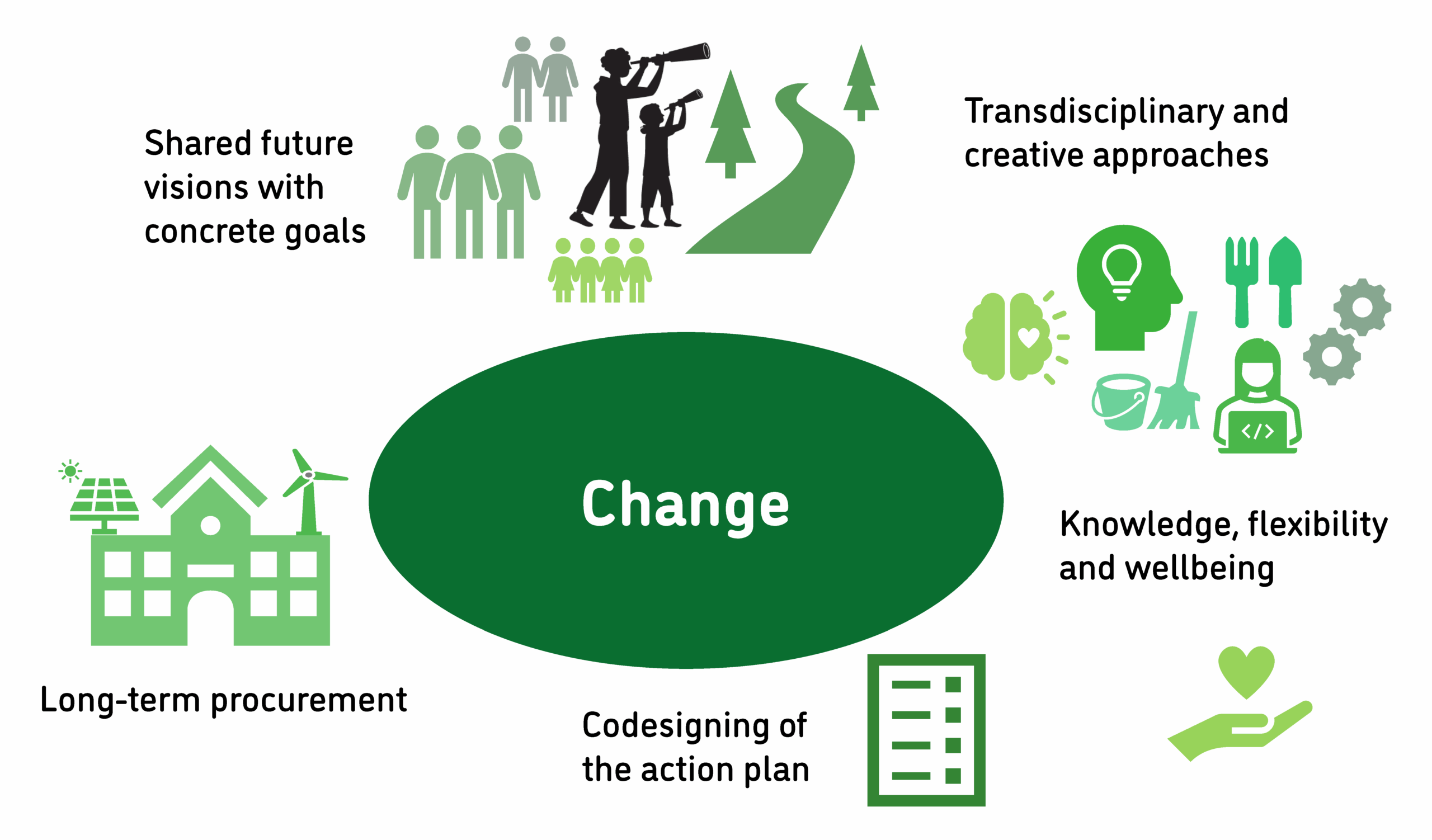
The change constructs through shared future visions with concrete goals, transdisciplinary and creative approaches, knowledge, flexibility and wellbeing and long-term procurement.
Stories about Change from the ECF4CLIM project schools and universities
-

Co-creating sustainability with busy upper secondary students
Read moreAt a Finnish upper secondary school, teachers were determined to engage students in environmental and sustainability issues, but they faced a common challenge: upper secondary students have very tight schedules and little time or interest in extracurricular activities.
-
Changing abandoned gardens and green spaces into living laboratories
Read moreAbandoned garden and green space reactivation plots were transformed into living laboratories with biotic gardens and educational vegetable beds.
-
Portugal and the change in demonstration sites
Read moreIn Portugal, the ECF4CLIM interventions demonstrated that change often begins with small, practical actions that gradually reshape school culture and daily routines.
-
Collected short examples about change from all countries
Read moreAll of the ECF4CLIM project countries had interventions concerning change.

Change and competences
The main perspectives in promoting change in educational settings are future, adaptation and innovation, as described above. Different dimensions of competences are simultaneously needed for tackling this change, and we should ponder how we can promote these different competences:
- Preparing individual students, teachers, headmasters, and other staff to understand future scenarios, develop their creativity, and remain resilient;
- Supporting collective structures, norms, and an organisational culture that fosters change;
- Making changes in the technical-material environment that enable sustainability transformation in schools and universities.
The individual, collective and technical-material possibilities are intertwined, with each sphere enabled by the other two.
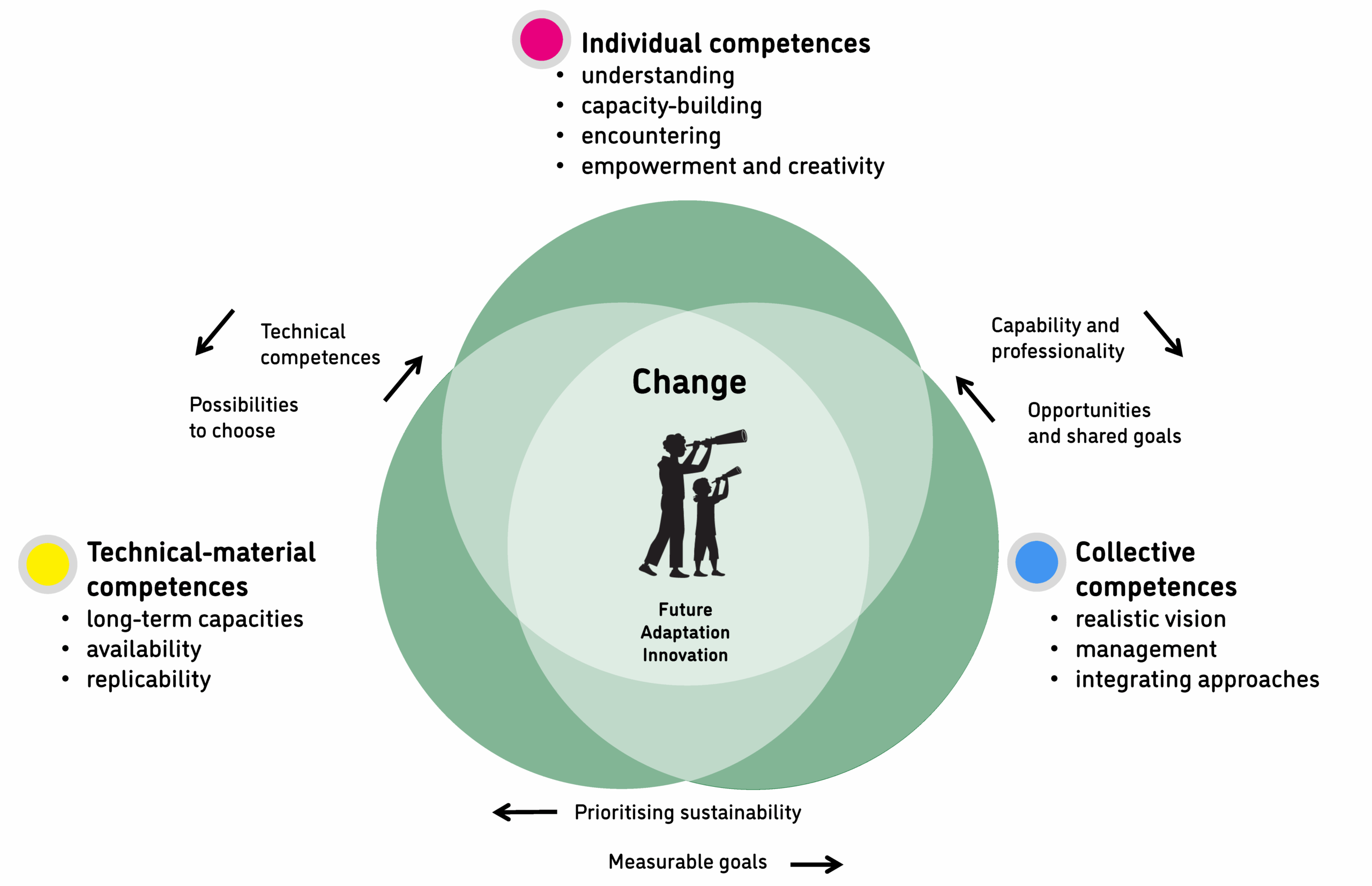
Coping with uncertainty, new circumstances, and the development of new solutions requires individual competences
Understanding future scenarios and new approaches require basic knowledge of ecology, society and science. Planning and using new equipment is not possible without creative and technological skills and understanding. The emotional load is also significant when encountering change, and personal flexibility, creativity and a positive attitude toward learning are essential. Additionally, working in transdisciplinary networks requires strong intrapersonal and collaboration skills. Leaders and teachers also need facilitation skills to guide the transformation toward sustainability. Beyond adaptation and the search for creative alternatives, resistance to unwanted changes and critical questioning are essential. However, in educational practice, teachers often find these approaches challenging.
The readiness of a school or university to change is embedded in its collective competences
The ability to create a shared vision depends on institutional structures and a cultural-cognitive atmosphere that supports development work. Regulations, such as collective labour contracts, can sometimes hinder flexible cooperation or limit opportunities for technical development. Transdisciplinary networks (including teachers, students, staff, families, service providers, municipalities, local associations, and businesses) create possibilities to integrate competences from diverse backgrounds into something new. Turning plans into written norms and strategies helps schools and universities, along with their stakeholders, work toward a common goal.
New technical-material competences are developed during the transition toward sustainability
How the technical-material competences evolve depends on the availability of technologies and resources within the school or university. Technical-material improvements can be considered for energy, water, waste, air quality, green procurement, transport, and green spaces. To avoid resource misuse, procurement should be critically assessed from a long-term perspective, considering life-cycles and maintenance possibilities. Ideally, the school or institution is able to innovate replicable technical-material changes that promote sustainability within the institution and serve as examples for others.
Individual, collective and technical-material competences related to change are deeply intertwined
Technical-material improvements are not possible without the competences, knowledge and skills of individuals. Conversely, if technical-material competences are lacking, and the change is needed, for example in waste management, individual attitudes or decisions do not help if recycling possibilities are unavailable.
The aspiration for technical-material changes toward sustainability can falter amid scarce resources, especially if the collective competences – such as the strategies of the school or university – prioritise other goals over sustainability. On the other hand, technical-material possibilities can support collective competences by offering concrete, measurable goals for institutions, goals that can be written in action plans.
Collective efforts and strategies can promote individual competences by providing opportunities for capacity-building for all members of the community. Plans and strategies also help individuals work toward shared collective goals. In turn, these plans, strategies, and goals do not develop without the contributions of capable individuals and the professional facilitation of the process by competent leaders.