

ACTION
Acting for sustainability
Our success in promoting sustainability depends on our ability to ‘walk the talk’. Schools and universities travel the sustainability path in many ways: they educate students to confront and address sustainability challenges, reduce the environmental impact of human activities in society by improving their own practices, and innovate novel solutions to sustainability problems. In practice, turning good intentions and shared goals into concrete action requires diverse competences from all members of the community, shared decision making, and support from both the social and material environment.
In practice, these competences are realised through action. Practitioners frequently discuss both the barriers and enablers that either hinder or support concrete action for sustainability. If concrete action plans, structures for cooperation, infrastructure and adequate resources are missing, progress toward sustainability becomes difficult. Additionally, those most interested in sustainability often feel that they alone are responsible for the efforts, even though all levels and actors are needed to work toward common sustainability goals in practice – policymakers and administrators, school leaders, teachers, other staff members, service providers, students, and parents. In the midst of global sustainability crises, doubts also arise about the relevance of local action in the broader picture.
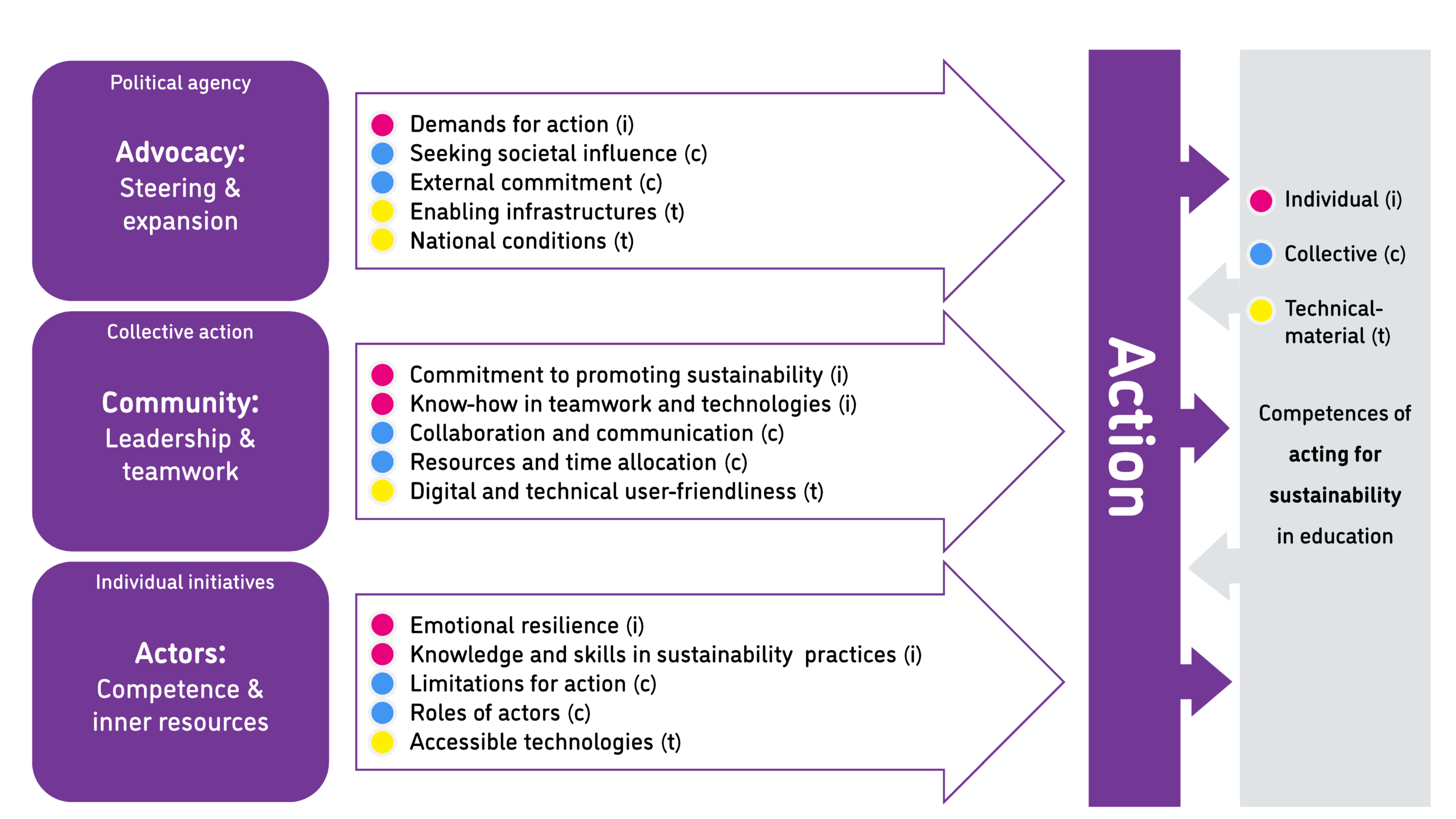





Advocacy means steering education towards sustainability and expansion of activities outside the school or university
Society outside of schools is increasingly interested in steering schools and universities towards sustainability, as education touches everyone at some point in their lives, and educational institutions are major public actors capable of promoting sustainability. External commitments – such as joining the Eco School programme or aligning with municipal strategies – connect the work of schools and universities to broader advocacy efforts, making their activities more effective. Often, when students learn about sustainability challenges and ways to promote sustainability, they begin to demand action from their school, university, or even from society at large. It is essential to link the activities of schools and universities to concrete actions that reduce environmental burdens. However, local infrastructure may not always support change, and national conditions – such as legislation, policies, trust in administration, bureaucracy, or corruption – can hinder progress. Sometimes, the attitude toward political action in schools is negative, even though political action refers to the widely approved promotion of sustainability, but at the societal level. Seeking societal influence, for example by serving as role models, can expand efforts and position schools and universities as agents of change.
To navigate the political system, identify political responsibility and accountability for unsustainable behaviour, and demand effective policies for sustainability.
- Political agency is the capacity to positively influence the collective future, by mobilising those at political level to take action for change. Political agency requires the capacity to analyse the context, spot possible avenues to move the sustainability agenda forward, and identify key stakeholders that can be brought on board to help achieve sustainability.
- Political agency can be focused towards advocating for a change in norms, rules, regulations, and institutional commitment for sustainability. However, it can also be directed towards the market and can push for green innovation or the promotion of lifestyle and behavioural changes. The green transition is one of the EU’s top strategic priorities, and the role of governments in meeting the associated challenges has become increasingly important. Many Europeans demand action to tackle sustainability problems from those responsible for making and implementing policies, who are ultimately responsible for our future and that of future generations. When asked who is responsible for tackling climate change, Europeans from 17 Member States ranked national governments first, while those from five Member States ranked business and industry first, and those from the other five Member States ranked the EU itself first.
- Political agency empowers learners to become agents of change and take part in a discussion that affects their futures. Furthermore, it shows learners that small actions can have widespread global repercussions and that by engaging others with ideas and activities that trigger reflection, everyone can contribute to political agency.
Read more from the GreenComp document that EU have published and where the direct quotes of this GreenComp section are copied.
Knowledge
Knows how political systems, including their components, should work for sustainability.
Knows the relevant political stakeholders for sustainability in one’s own community.
Knows how to engage with political and economic stakeholders to co-create sustainability policies with community representatives.
Knows policies that assign responsibility for environmental damage (e.g. “polluter pays”).
Skills
Can analyse how power structures and political systems exert influence.
Can engage in democratic decision making and civic activities for sustainable development.
Can identify relevant social, political and economic stakeholders in one’s own community and region to address a sustainability problem.
Can propose alternative pathways for sustainability.
Attitudes
Is committed to becoming an agent of change to achieve sustainability.
Expects governments and public institutions to serve the common good.
Demands political accountability for unsustainable behaviour.
Is committed to questioning the effectiveness of policies for sustainability.
- Steering of schools and universities toward sustainability and including sustainability in their curricula (c)

- Increasing resources for sustainability in education (c)
- Sharing projects with other schools or universities to increase impact (c)
- Joining eco-school or green school networks (c)
- Mapping the possibilities to participate in societal transformations (i)
- Sharing knowledge, information and practices with families and local communities; taking action in neighbourhoods or the municipality (i)
- Discussions on how to positively address sustainability challenges (i)
- Developing resilience and questioning normal ways of doing things (i)
- Collaborating beyond one’s own school or university, e.g. municipality, city transport agency, external contractors, private companies, NGOs (i)
- Making initiatives for better infrastructure or national policies (t)(c)


 (c)
(c)
Creating or strengthening:
-
-
-
-
-
-
-
-
- (i)=individual competence
- (c)= collective competence
- (t)= technical-material competence
- (i)=individual competence
-
-
-
-
-
-
-
- National or local administration does not support sustainability efforts (c)
- Poor competences in communicating the goals, action plan and advantages clearly to external actors (i)
- Lacking resources for sustainability efforts (c)
- Scarcity of connections with families (c)
- Educational institutions resistant to questioning normal ways of doing things (c)
- Discrepancy between what the curriculum says and what teachers teach in the classroom (i)
Creating or strengthening:
-
-
-
-
-
-
-
-
- (i)=individual competence
- (c)= collective competence
- (t)= technical-material competence
- (i)=individual competence
-
-
-
-
-
-
-
- How do you foster a school culture that encourages questioning the status quo and embracing sustainability? What is your influence?
- What role can your school play in broader societal transformations?
- How could you collaborate with other schools or external actors (e.g., NGOs, municipalities) to amplify sustainability efforts?
- How can you support students in developing political agency for sustainability?
- What kinds of activities would you like to take part in to influence change in your neighbourhood or municipality?
In a community, leadership and teamwork facilitates action
Promoting sustainability in schools requires the personal commitment of all community members, especially leaders such as headmasters and teacher facilitators of sustainability education. Teamwork and the use of new technical equipment also demand specialised knowledge and skills. Curricula with a strong sustainability initiative help actors to include sustainability efforts in everyday life. Additionally, clear and consistent communication of the course of action to all members is crucial. Transdisciplinary collaboration among different stakeholders remains essential even after shared goals have been established, particularly for reviewing the course and assessing the outcomes of sustainability efforts. Sufficient financial and human resources, as well as time, should be allocated to ensure progress. The digital and technical environment should be seamlessly integrated into the community’s activities to make the best use of available opportunities.
To act for change in collaboration with others
- Collective action as a competence stems from recognising that the role communities and civil society organisations play in achieving sustainability is fundamental. Collective action calls for coordination, collaboration and cooperation among peers. By acting together and working to achieve the same goal, people can find opportunities and meet challenges to contribute effectively to solving sustainability problems at the local level.
- Taken together, this will have an impact at the global level. Collective action develops learners’ ‘ability and will to take part in democratic processes concerning man’s use of and dependence on natural resources in a critical way’
Read more from the GreenComp document that EU have published and where the direct quotes of this GreenComp section are copied.
Knowledge
Knows the main sustainability stakeholders in one’s own community and how to contact them.
Knows that working with others to promote nature and support fairness requires respect for democracy.
Knows how to work with diverse participants to create inclusive visions for a more sustainable future.
Knows the importance of empowering individuals and organisations to work collaboratively.
Skills
Can build diverse coalitions to address wicked problems related to sustainability.
Can create transparent, inclusive and community-driven processes.
Can create opportunities for joint action across communities, sectors and regions.
Can work collectively in sustainability change processes.
Can identify stakeholders’ strengths.
Can act in line with shared narratives on sustainable futures.
Attitudes
Is willing to engage with others to challenge the status quo.
Is motivated to collaborate in order to shape inclusive sustainable futures.
Prioritises sustainability values and interests when taking collective action.
Wants to give back to the community and nature.
Is committed to change for a more inclusive and fair future.
- Adding sustainability to the school’s plans, as a visible part of them, to gain legitimacy, resources and morale (c)
- Providing tools, materials, guides, templates, training and practical support for planning, implementing and assessing individual actions or interventions (c)
- Designing a clear schedule and teamwork and allocating financial and time resources to design, coordinate and implement sustainability interventions (c)
- Using projects to strengthen strategic orientations (c)
- Making a system of rotating roles (e.g., monthly ‘eco-officer’) to distribute the maintenance burden without creating ongoing extra work (c)
- Designing training activities/seminars for teachers and the entire organisation to discuss the role of sustainability in education (c)
- Committed, clear and value-driven, distributed leadership, teachers and students (i)
- Relating activities to subject matter across different subjects and courses (i)
- Finding and using the most effective internal communication channels, and through it, engaging the whole community (i)
- Assessing the results (i)
- Well-being and emotional climate are as important as technical planning (i)
- Using KPIs to help translate abstract sustainability concepts into tangible, local actions and to offer concrete anchors for activities. (t)
- Purchasing digital and technical solutions to secure operational capacity (t)
Creating or strengthening:
-
-
-
-
-
-
-
-
- (i)=individual competence
- (c)= collective competence
- (t)= technical-material competence
- (i)=individual competence
-
-
-
-
-
-
-
- Scarcity or complete lack of financing. For less-resourced schools, even small improvements might be difficult to sustain or replicate (c)
- Hurry, lack of time, or too much time between team meetings: without time management competences and scheduling, even well-resourced projects stall (c)
- Everything on the same shoulders – many activities carried out thanks to the voluntary initiative of a few actors committed to sustainability (c)
- Lacking technical user-friendliness (t) and competence: lack of installations and ongoing maintenance to ensure equipment is functional and educationally useful (i)
- Poor information, communication or advertising of sustainability action (i)
- Missing municipal approvals for installations (c)
- Leadership remains absent, passive or personal rather than distributed (i)
- Poor usability and accessibility of technical equipment (t)
Creating or strengthening:
-
-
-
-
-
-
-
-
- (i)=individual competence
- (c)= collective competence
- (t)= technical-material competence
- (i)=individual competence
-
-
-
-
-
-
-
- What would help you dedicate more time to sustainability work without overburdening your schedule?
- What structures are in place to ensure leadership is distributed?
- How do you engage families, external experts and municipal actors?
- How would you improve communication about your school’s sustainability work in ways that would spark your interest?
Individual actors need competence and inner resources
Taking action toward sustainability in schools can be emotionally challenging due to numerous barriers and lack of clear solutions to global problems. Therefore, resilience, sustainability knowledge, and practical personal skills are essential. Understanding limitations helps individuals navigate obstacles and continue progressing. One person does not have to manage everything – different actors can take on different roles in promoting sustainability. One helpful tip is to choose accessible technologies that are easy to use and maintain.
To identify own potential for sustainability and to actively contribute to improving prospects for the community and the planet
- Individual initiative relies on someone knowing what types of action are possible, having confidence in their own potential to influence change (internal locus of control), and being willing to act.
- Recognising what types of action are possible and being aware of one’s own potential in terms of sustainability problems are the first steps someone needs to take in order to seize the initiative as an individual. However, individual initiative does not only rely on opportunities for action and someone’s self-awareness and self-efficacy. It also has a strong attitudinal aspect – the willingness to act.
- Individual initiative nurtures the entrepreneurial mindset of individuals and empowers them take the initiative in their lives. By taking action in their personal sphere, individuals can act as agents of change and role models, inspiring their peers to try to achieve sustainability. This could also help debunk myths on behaviour related to sustainability, e.g. a sustainable lifestyle is more expensive than a non-sustainable one, and of a lower quality.
- Furthermore, individual initiative encourages people to take preventive action when certain actions or inaction may have damaging consequences for human health and all life forms (precautionary principle). Rather than waiting for evidence in order to act, in case of uncertainty it may be advisable to act because it may be too harmful, or too late, to wait for evidence to emerge.
Read more from the GreenComp document that EU have published and where the direct quotes of this GreenComp section are copied.
Knowledge
Knows one’s own potential to bring about positive environmental change.
Knows that preventive action should be taken when certain action or inaction may damage human health and all life forms (precautionary principle).
Knows that individuals have a commitment towards society and the environment.
Knows that maintaining the status quo and inaction are also choices.
Knows that every action has an impact even if not immediate.
Skills
Can apply the following principles: using fewer resources, doing better with fewer resources, and reusing the same resources.
Can take personal initiative and persist in achieving sustainability objectives even in contexts of uncertainty.
Can act promptly, even in the face of uncertainty and unforeseen events, keeping in mind the precautionary principle.
Can mobilise others to adopt more sustainable choices.
Can overcome one’s own resistance to change.
Can identify a network of relevant stakeholders.
Attitudes
Cares proactively for the planet.
Is willing to take action to try to solve complex sustainability problems.
Advocates for individual and collective care for those in need and for the planet.
Is confident about anticipating and influencing sustainable changes.
Recognises that everyday action matters.
- Leadership by principals and senior staff alone is insufficient; the skills and commitment of teachers and students are equally vital (i)
- Context-specific know-how matters, and targeted skills training is mandatory (e.g. staff able to manage or instruct advanced systems) (c)(i)
- Treating digital proficiency as a distinct competence rather than a background condition ensures that actors are not only users but also capable maintainers and adaptors of the tool (c)
- Knowledge about the environment and systems to create suitable strategies (i)
- Projects thrive when a head teacher, university administrator, or student champion embodies committed and informed environmental leadership, secures resources, and keeps momentum alive (i)
- Transforming sustainability ideas into tangible outcomes requires competence in planning, scheduling, delegation, and coordination (i)
- Knowing one’s own potential, limits and resources – such as juggling exams, heavy timetables or shift work – enables interventions and prevents burnout (i)
Creating or strengthening:
-
-
-
-
-
-
-
-
- (i)=individual competence
- (c)= collective competence
- (t)= technical-material competence
- (i)=individual competence
-
-
-
-
-
-
-
- Inconsistencies of leaders reduce students’ and teachers’ efforts (i)
- Limited time, academic pressures, and emotional fatigue pose constraints for all members of the community (c)
- Technical fears, resistance or hesitation towards unfamiliar technologies and interacting with systems, due to a lack of confidence, limited prior exposure, or concerns about handling complex systems (c)
- Complicated systems that are difficult to use (t)
- Communication breakdowns undermining impact. (c)
Creating or strengthening:
-
-
-
-
-
-
-
-
- (i)=individual competence
- (c)= collective competence
- (t)= technical-material competence
- (i)=individual competence
-
-
-
-
-
-
-
- How do you ensure that sustainability leadership is shared among staff and students, not concentrated on a few individuals
- How do you support emotional resilience and well-being in your school community during sustainability transitions?
- What strategies help you recognise and respect your own limits while staying engaged in sustainability efforts?
- How can you take initiative in sustainability projects even when leadership is inconsistent or passive?
- How do you embody environmental leadership in your role?
- What are the best ways to communicate ideas and actions to students in your school?
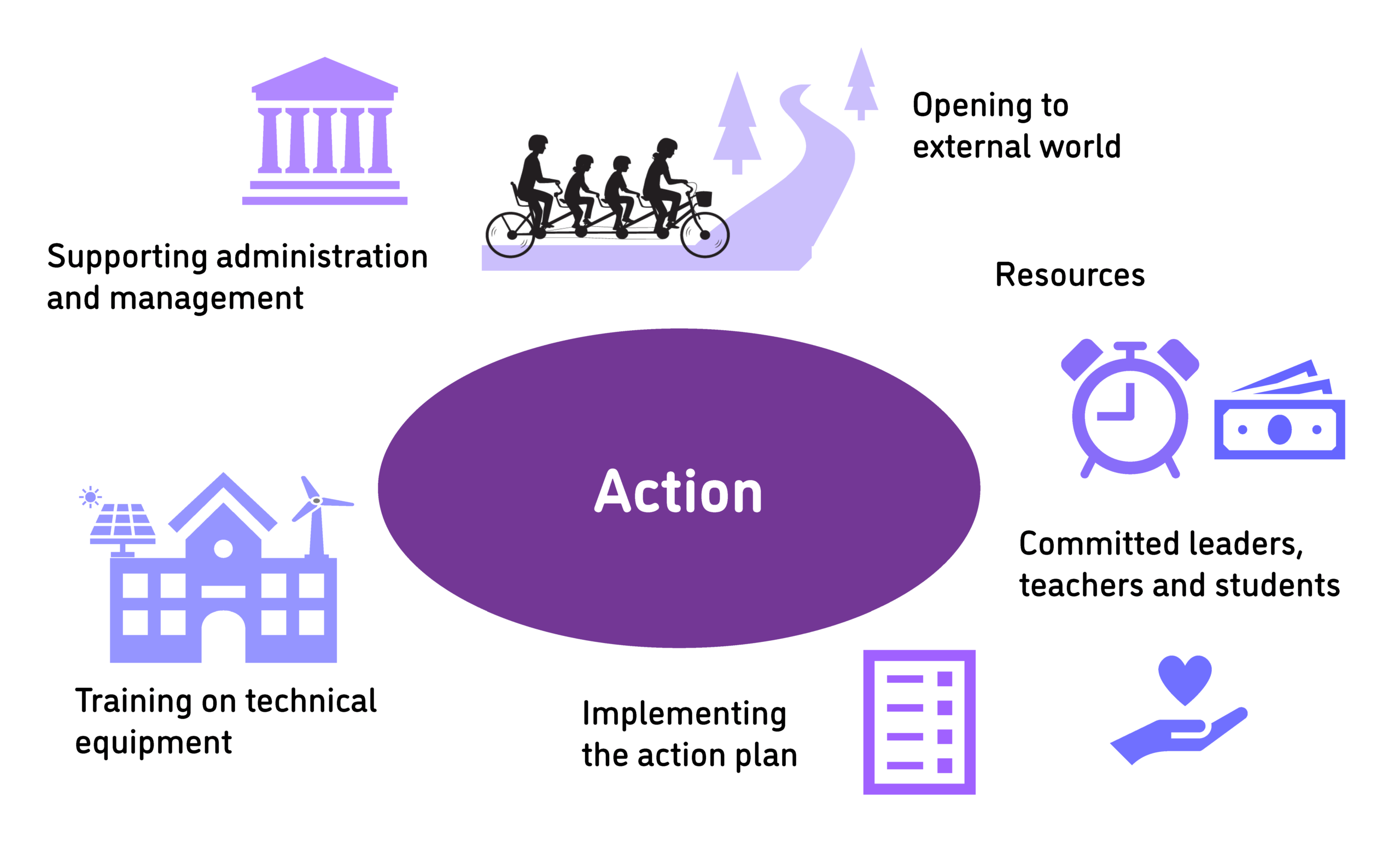
Action is enabled by committed leaders, supporting administration and management, teachers and students, training on technical equipment, implementing the action plan and opening to external world.
Stories about Action from the ECF4CLIM project schools and universities
-

Learning through establishing solar panels
Read moreAcross several ECF4CLIM demonstration sites, solar panels have been installed – not just as technical upgrades, but as learning opportunities. These structural interventions required collaboration both within schools and universities, and also with municipalities.
-
Action despite the constraints in Portugal
Read moreAt Bobadela School, located northeast of the capital city of Portugal, Lisbon, the project started with the headmaster’s proposal. In order to engage the entire community and establish a participatory approach, the school decided to conduct surveys and quizzes about sustainability with the entire community. It was important for everyone to give their opinion and thus take part in the project.
-
Portugal and technical solutions
Read moreIn Portugal several interventions illustrated how concrete actions can serve as powerful drivers of environmental learning and institutional change.
-
Collected short examples from all countries
Read moreSchools learned a lot about action during the ECF4CLIM project.

Action and competences
In educational settings, it is useful to scrutinise action from perspectives of advocacy, community and actors, as described above. Competences at different levels are simultaneously needed for successful action. We should reflect on how we can promote these competences:
- Supporting all individual actors in schools and universities and strengthening their competences in advocacy, cooperation and understanding best practices;
- Supporting collective practices – such as norms, rules and established practices – to promote a school’s or university’s ability to implement its sustainability goals;
- Supporting technical and material solutions to promote sustainability actions in education and to help minimise the environmental impact of schools and universities.
The individual, collective and technical-material possibilities are intertwined, with each area enabled by the other two.
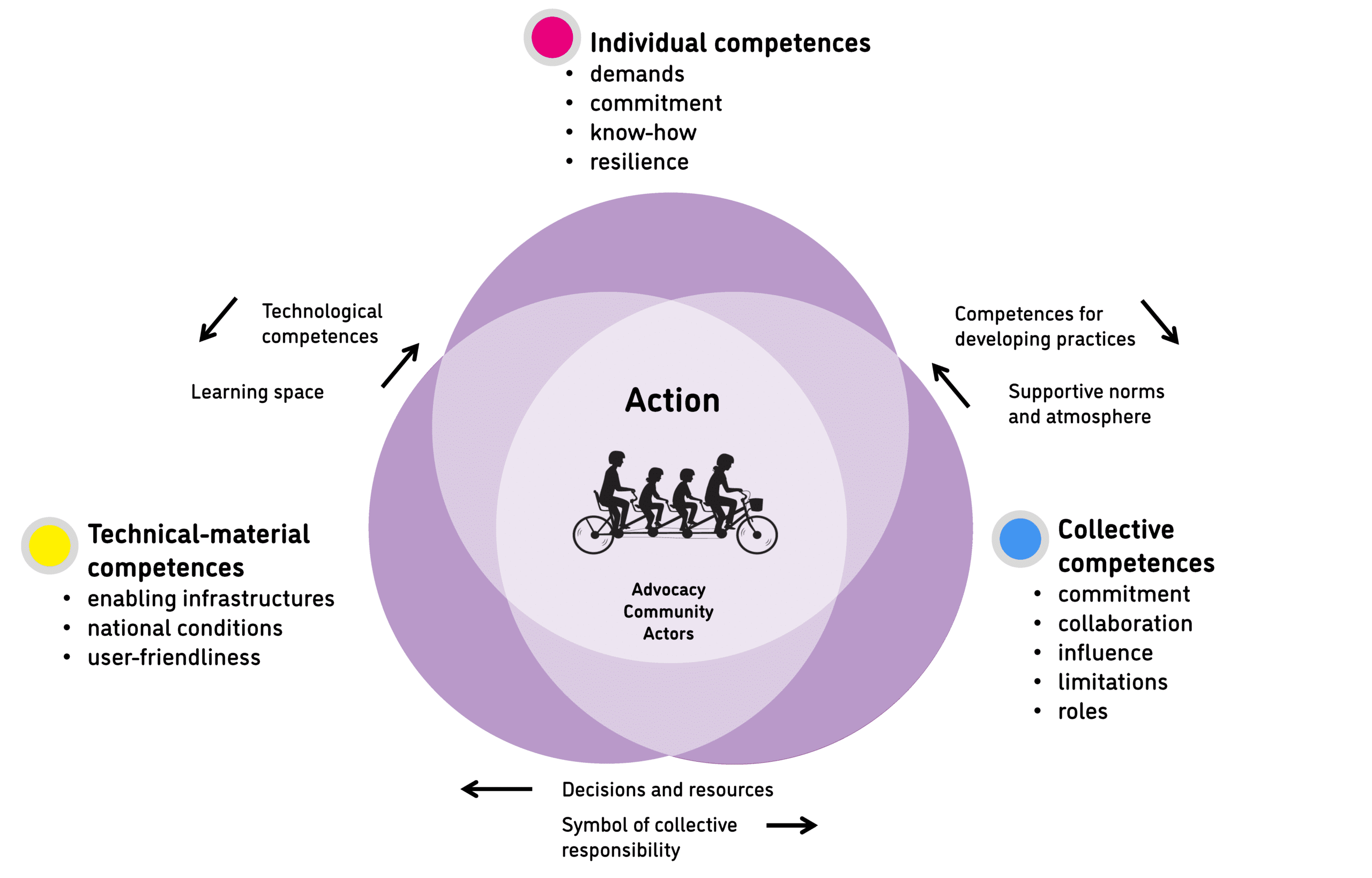
Action requires individual competences
Individuals need practical knowledge on sustainability and how to translate goals into concrete actions, skills to carry out planned activities, and a positive attitude and commitment to sustainability efforts and proactive advocacy. Leaders, in particular, need competences to guide and facilitate the process, support others, communicate the goals, collaborate with community members in different roles, and make pro-environmental suggestions and decisions while negotiating with external actors. The ability to flatten hierarchies and invite diverse community members to participate in sustainability efforts – from their own starting points – is crucial. When technical equipment is used, individuals must have the ability to operate and maintain it over the long term. Ideally, the technical-material environment also serves as a tool for learning.
Action is not possible without collective competences
The main barrier to sustainability efforts is lack of resources: general plans and norms do not automatically translate into concrete actions. Even detailed action plans with clearly defined responsibilities and corresponding decisions are necessary. In promoting sustainability, time is the scarcest resource. Without sufficient time, cooperation becomes impossible and the implementation of actions remains incomplete. Competent personnel are also essential. Allocating working hours for sustainability efforts, creating local sustainability policies and making technical improvements all require financial resources. Often, in addition to internal development, changes in external systems are needed – making functional cooperation networks crucial. Designing long-lasting, well-organised and well-resourced sustainability practices reduces the need for resources in the long run. Additionally, a collective, positive spirit of action for sustainability is a valuable asset in schools and universities. These barriers to action reflect the dimensions described in the Theory of Practice Architectures: cultural-discursive, material-economic and social-political arrangements. Critically exploring actions through these dimensions may help educational institutions identify solutions for more sustainable practices and action.
Technical-material competences are part of sustainable action
Equipment that restricts the use of water or energy, adequate infrastructure, usable green spaces, and a functioning recycling system, are part of sustainable action. In reality, utilising technical solutions requires resources and good enough infrastructure, and the possibilities for improving the technical-material environment in practice vary across countries. When it comes to technical equipment, user-friendliness and accessibility are the key considerations. If the life cycle is not taken into account, maintenance is difficult, or teachers require advanced skills or knowledge to use the equipment in teaching, then expensive procurements may shift from being competences to becoming environmental burdens.
Individual, collective and technical-material competences related to action are deeply intertwined
For example, using technical-material systems requires individual competences from the users. In turn, the technical-material environment provides a learning space that enables hands-on, experiential learning for individual students – proven to be effective in sustainability education.
Technical-material environments serve as a showcase and a concrete field for collective action, being a symbol of collective responsibility and awareness. Conversely, without collective decisions and resources, the development of technical-material competences is not possible.
Individual competences are essential for developing collective practices and action within schools and universities. However, restrictive collective norms can hinder individual initiatives, while positive practices and a supportive atmosphere foster individual learning, advocacy and action.