
-

Common Swift – Apus apus
Ómar Runólfsson, Swift – Apus apus – Múrsvölungur. Creative Commons BY-NC-SA-2.0
Ómar Runólfsson, Creative Commons Attribution Noncommercial Share-Alike 2.0
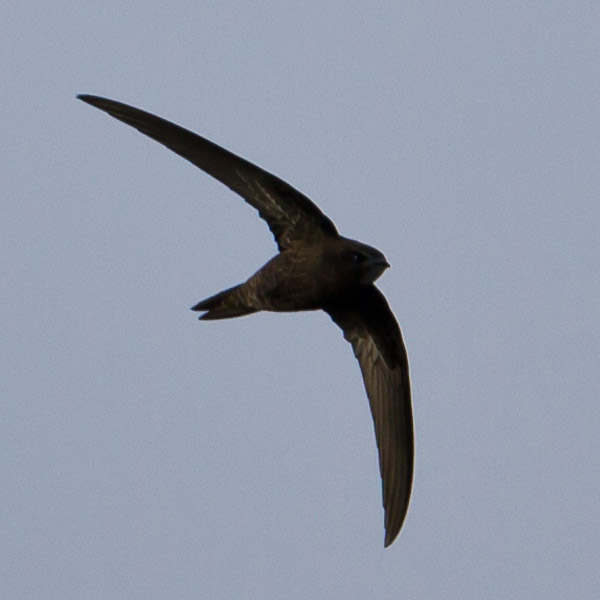
Common Swift
(fi: tervapääsky, sv: tornseglare)
Apus apus
Identification
The Common swift is a medium-sized aerial bird. Plain brown, with a white throat, with long curved wings and a forked tail, that can be put together to sharp point. No significant difference in looks between males and females. Listen to swift’s call by clicking the button above.
Habitat
It mainly inhabits urban environments but can also nest on rocky walls and sea cliffs.
Nutrition
Diet consists mainly of insects caught in open gape in flight.
Breeding
Swifts mostly breed in towns and villages, and rarely in deserted wooded areas or cliffs. They pair for life, returning to the same site each year for a little nest renovation before laying and incubating their eggs. Only when breeding do they sleep and rest in the nest.
Migration
Migrants, in Europe they are summer visitors, overwintering in South Africa. They spend most of their life flying, when migrating and in winter they sleep most nights at high altitudes in the air.
Distribution
Common Swifts breed across Europe and parts of western Asia, from the UK to Russia. They migrate to sub-Saharan Africa for winter, traveling long distances between breeding and wintering areas.
Status and conservation
IUCN status is Least Concern, but populations are declining in some areas. BirdLife works to protect swifts and nesting sites in cities. In Finland it is Endangered due to habitat loss, fewer insects, and population decline.
Cultural heritage
In Slovenia, swifts are seen as bringers of spring and protectors of forests, also linked to storms in folklore. In Romania, Italy and Finland they are associated with summer, migration, weather signs, protection of homes and sacred or lucky birds. Read more from the booklet.
Explore the factors affecting the species
Organism groups
Endangered status in Finland
ENDANGERED CATEGORY (International Union for Conservation of Nature (IUCN) classification)
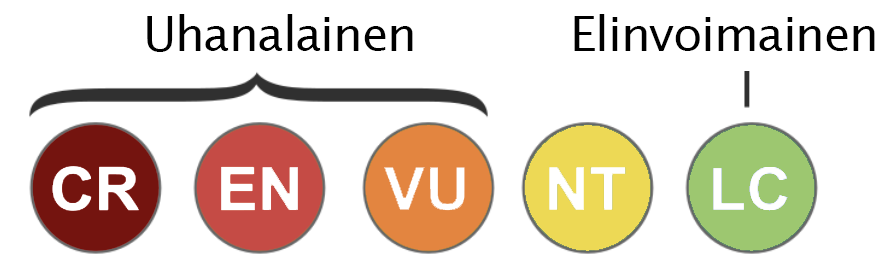
CR Critically endangered
EN Endangered
VU Endangered
NT Near threatened
LC Least concern
2019 EN - endangered
2015 VU - vulnerable
2010 LC - least concern
2000 LC - least concern
Regulations
Threatened species (NCD 2023/1066, Appendix 6)
The Nature Conservation Decree can regulate a wild species whose natural survival in Finland has been endangered as an endangered species.
Safeguarding Endangered Species in Forestry – Lajiturva Project 2019–2021