
-

Black-headed Gull – Larus ridibundus
Ómar Runólfsson, Black-headed Gull – Chroicocephalus ridibundus – Hettumáfur. Creative Commons BY-NC-SA-2.0
Ómar Runólfsson, Creative Commons Attribution Noncommercial Share-Alike 2.0
-
Black-headed Gull – Larus ridibundus
Aki Aintila, Creative Commons Attribution Noncommercial Noderivatives 4.0


Black-headed Gull
(fi: naurulokki, sv: skrattmås)
Larus ridibundus
A noisy and social key species, which adapts well to both natural and urban environments.
Identification
A small gull with white body, grey wings, and red legs. In summer it has a dark brown head. In winter only dark spots behind the eyes remain.
Habitat
Lives in lakes, wetlands, coasts, and cities. Often nests on small islands or in dense vegetation near water, sometimes close to humans.
Nutrition
Feeds on insects, worms, fish, and seeds. Also scavenges food from human environments such as fields, harbours, and rubbish sites.
Breeding
Breeds in large colonies which protect nests from predators. Acts as a key species: other waterbirds nest nearby to gain safety from the colony. The nest is built from plant material on the ground or floating vegetation near water.
Migration
Short distance migratory bird. Most Finnish black-headed gulls winter in western Europe, returning to Finland in early spring.
Distribution
Widespread across Europe and Asia. Common throughout most of Finland, especially near water bodies.
Status and conservation
Globally Least Concern (LC). In Finland considered vulnerable (VU). In Finland the population declined since the 1970’s due to invasive predators, agricultural changes, and reduced food at landfills, but has stabilised in the 2000’s.
Cultural heritage
Gulls are often associated with the sea, harbours, and fishing. In Finnish folk tradition, they were seen as the souls of sailors. The name of the Black-headed Gull refers to its laughing call, also reflected in its scientific name ridibundus.
Explore the factors affecting the species
Organism groups
Endangered status in Finland
ENDANGERED CATEGORY (International Union for Conservation of Nature (IUCN) classification)
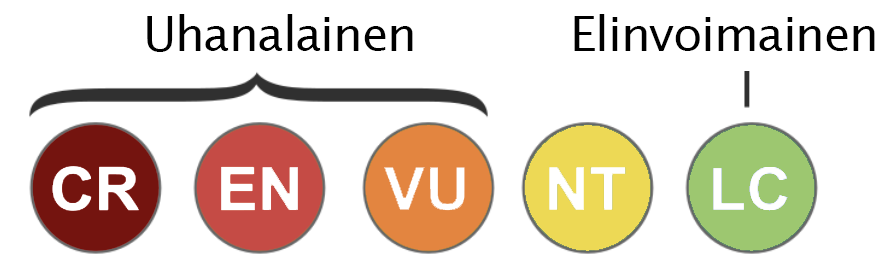
CR Critically endangered
EN Endangered
VU Endangered
NT Near threatened
LC Least concern
2019 VU - vulnerable
2015 VU - vulnerable
2010 NT - near threatened
2000 VU - vulnerable
Regulations
Threatened species (NCD 2023/1066, Appendix 6)
The Nature Conservation Decree can regulate a wild species whose natural survival in Finland has been endangered as an endangered species.
Migratory birds of the EU Birds Directive
Migratory species that occur regularly in Finland, for the protection of which must be taken similar measures to those for Annex I species (eg the establishment of Natura 2000 sites).