
-

Common Blackbird – Turdus merula
Esa Pitkänen, Mustarastas. Creative Commons BY-NC-SA-2.0
Esa Pitkänen, Creative Commons Attribution Noncommercial Share-Alike 2.0
-
Common Blackbird – Turdus merula
Pekka Malinen, Creative Commons Attribution Noncommercial Share-Alike 4.0


Common Blackbird
(fi: mustarastas, sv: koltrast)
Turdus merula
Identification
Male Blackbirds are black with a bright orange-yellow beak and yellow eye-ring. Females are brown often with spots and streaks on their breasts and brown beak. Listen to Blackbird’s song by clicking the button above.
Habitat
Its main and original habitat is relatively open broadleaf, coniferous, mixed and deciduous forests but it is also found in tree plantations, orchards, farmland, gardens and parks and commonly in open grassy areas so long as vegetation cover is within a short distance.
Nutrition
It is a highly flexible and adaptive forager and feeds principally on invertebrates, mainly earthworms and insects and their larvae but will also take fruits and seeds and, occasionally, small vertebrates.
Breeding
In Europe it breeds from mid-March to early September. The nest is a large cup of dry grass stems and small twigs, packed with mud and lined with fine grass and stems in a bush or tree, frequently in or on a wall, outside or inside a building.
Migration
Resident to short distance migrants, depending on the population. Mainly a nocturnal migrant. Birds breeding in northern Europe generally migrates south or west. Breeders in southeastern Europe and northwestern Africa are essentially non-migratory.
Distribution
Common blackbird is widely distributed across Europe, parts of Asia and North Africa, and has been introduced to Australia and New Zealand, inhabiting gardens, forests and hedgerows in urban and rural environments.
Status and conservation
IUCN assessment of this is Least Concern (LC) due to its large range, large population and increasing trend. Local threats include agriculture intensification, hunting, cats, disturbance, weather and nest failure.
Cultural heritage
The Common blackbird is deeply rooted in European folklore, music and poetry, symbolising nature and seasonal change across Europe. Read more details from the booklet.
Explore the factors affecting the species
Organism groups
Endangered status in Finland
ENDANGERED CATEGORY (International Union for Conservation of Nature (IUCN) classification)
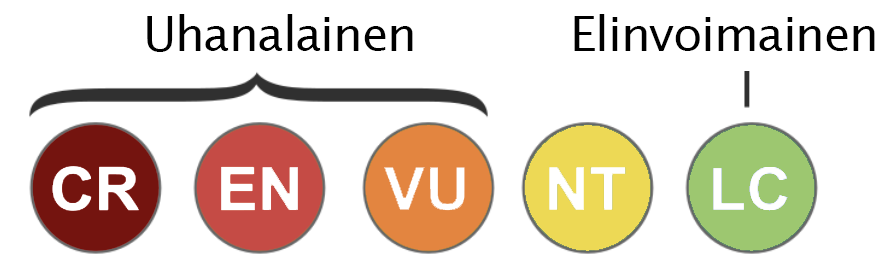
CR Critically endangered
EN Endangered
VU Endangered
NT Near threatened
LC Least concern
2019 LC - least concern
2015 LC - least concern
2010 LC - least concern
2000 LC - least concern
Regulations
No regulations.