
-

Golden Eagle – Aquila chrysaetos
Aleksi Lehikoinen, Creative Commons Attribution Noncommercial Noderivatives 4.0
-
Golden Eagle – Aquila chrysaetos
danielguip, Aigle royal (Aquila chrysaetos). Creative Commons BY-NC-SA-2.0
danielguip, Creative Commons Attribution Noncommercial Share-Alike 2.0
-
Golden Eagle – Aquila chrysaetos
Martti Perämäki, Creative Commons Attribution Noncommercial Noderivatives 4.0
-
Golden Eagle – Aquila chrysaetos
Martti Perämäki, Creative Commons Attribution Noncommercial Noderivatives 4.0
-
Golden Eagle – Aquila chrysaetos
Sari Holopainen, Creative Commons Attribution Noncommercial Noderivatives 4.0
-
Golden Eagle – Aquila chrysaetos
Petri Timonen, Creative Commons Attribution Noncommercial Noderivatives 4.0
-
Golden Eagle – Aquila chrysaetos
Petri Timonen, Creative Commons Attribution Noncommercial Noderivatives 4.0
-
Golden Eagle – Aquila chrysaetos
Petri Timonen, Creative Commons Attribution Noncommercial Noderivatives 4.0
-
Golden Eagle – Aquila chrysaetos
Petri Timonen, Creative Commons Attribution Noncommercial Noderivatives 4.0
-
Golden Eagle – Aquila chrysaetos
Petri Timonen, Creative Commons Attribution Noncommercial Noderivatives 4.0

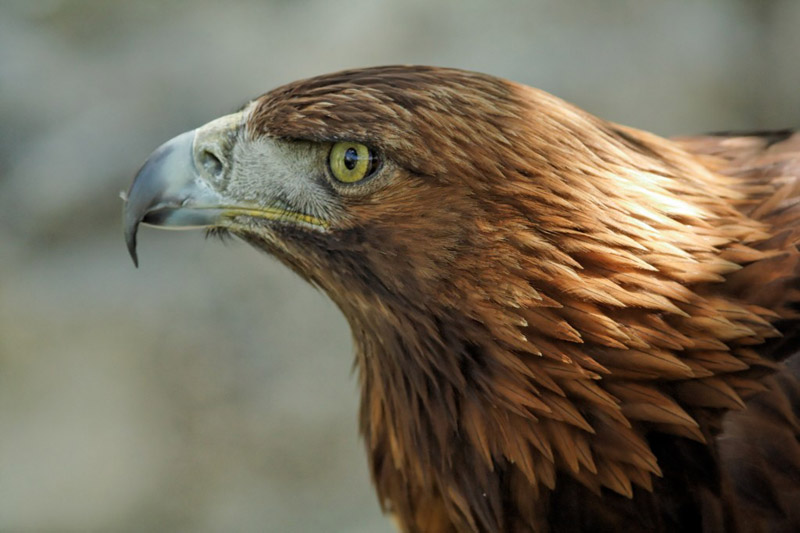


Golden Eagle
(fi: maakotka, sv: kungsörn)
Aquila chrysaetos
A powerful bird of prey, known for its strength and impressive hunting skills.
Identification
A large dark brown eagle with golden feathers on the back of the head and neck. Broad wings and strong talons.
Habitat
The Golden Eagle prefers mountains, cliffs, and open landscapes such as grasslands and tundra.
Nutrition
Feeds mainly on mammals like hares and rodents, but also birds and carrion.
Breeding
Builds large nests (eyries) on cliffs or trees. Lays 1–3 eggs. Usually only one chick survives.
Migration
Partially migratory. Some populations stay year-round, others move south in winter.
Distribution
Found across Europe, Asia, North America, and parts of North Africa.
Status and conservation
Globally Least Concern (LC), but locally threatened by habitat loss and human disturbance.
Cultural heritage
Globally Least Concern (LC), but locally threatened by habitat loss and human disturbance.
Organism groups
Endangered status in Finland
ENDANGERED CATEGORY (International Union for Conservation of Nature (IUCN) classification)
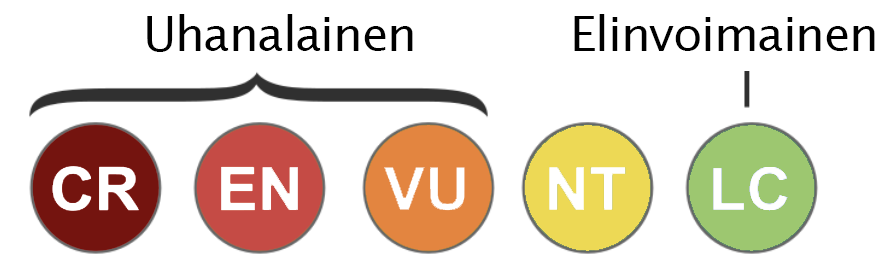
CR Critically endangered
EN Endangered
VU Endangered
NT Near threatened
LC Least concern
2019 VU - vulnerable
2015 VU - vulnerable
2010 VU - vulnerable
2000 VU - vulnerable
Regulations
Threatened species (NCD 2023/1066, Appendix 6)
The Nature Conservation Decree can regulate a wild species whose natural survival in Finland has been endangered as an endangered species.
Large birds of prey (NCD 2023/9, 73 §)
The nesting tree of a large bird of prey, where the nest is in regular use and clearly visible, is protected.
EU Directive on Conservation of Wild Birds Annex I
Convention on International Trade in Endangered Species of Wild Flora and Fauna - CITES, Appendix II
EU regulation regarding CITES, Appendix A
OUTDATED Species to be protected urgently (Finnish Environment Institute 2010-2011)
Safeguarding Endangered Species in Forestry – Lajiturva Project 2019–2021
OUTDATED Threatened species (NCD 1997/160, Appendix 4 2013/471)
OUTDATED Species under strict protection (NCD 1997/160, Appendix 4 2013/471)