
-

Tawny Owl – Strix aluco
Aleksi Lehikoinen, Creative Commons Attribution Noncommercial Noderivatives 4.0
-
Tawny Owl – Strix aluco
Bohuš Číčel, Strix aluco, Herálec, Czech Republic. Creative Commons BY-SA-3.0
Bohuš Číčel, Creative Commons Attribution Share-Alike 3.0
-
Tawny Owl – Strix aluco
Veli-Matti Väänänen, Creative Commons Attribution Noncommercial Noderivatives 4.0
-
Tawny Owl – Strix aluco
Veli-Matti Väänänen, Creative Commons Attribution Noncommercial Noderivatives 4.0
-
Tawny Owl – Strix aluco
Veli-Matti Väänänen, Creative Commons Attribution Noncommercial Noderivatives 4.0



.jpg)
Tawny Owl
(fi: lehtopöllö, sv: kattuggla)
Strix aluco
The mysterious voice of the European forests
Identification
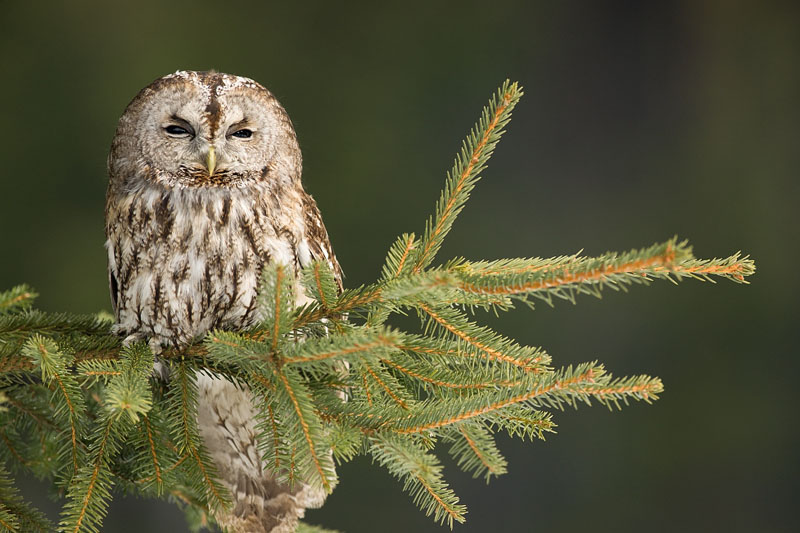
With its rounded head, large dark eyes, and soft mottled plumage in shades of brown, grey, and cream, the Tawny Owl blends perfectly into tree bark, becoming almost invisible during the day. Unlike many other owls, it has no ear tufts, giving it a smooth, gentle silhouette.
Habitat
The Tawny Owl is commonly associated with broad-leaved and mixed woodlands, but its adaptability allows it to thrive in urban parks, gardens, and farmland with adequate tree cover.
Nutrition
The Tawny Owl feeds on small mammals, birds, and insects, gliding through the darkness with remarkable precision thanks to its specialized feathers that muffle sound.
Breeding
The Tawny Owl does not build any nests, but merely uses tree cavities, uninhabited houses, and if necessary, nest boxes. It may settle under roofs or in chimneys. It also occupies nests abandoned by other raptors.
Migration
The Tawny Owl does not migrate and remains closely tied to its territory throughout the year.
Distribution
The Tawny Owl is found throughout most of the continent, from the United Kingdom and the Iberian Peninsula across France, Germany, and Italy, and extending eastward into parts of Eastern Europe. Its range also reaches Scandinavia, although it is less common in the far north where winters are particularly harsh.
Status and conservation
The Tawny Owl currently has a favorable conservation status throughout Europe. In most parts of its range, the species is showing a gradual and steady increase.
Cultural heritage
The Tawny Owl appears in folklore and literature as a symbol of wisdom, mystery, and the unknown, its haunting call and nocturnal habits giving it a lasting place in the European imagination.
Organism groups
Endangered status in Finland
ENDANGERED CATEGORY (International Union for Conservation of Nature (IUCN) classification)
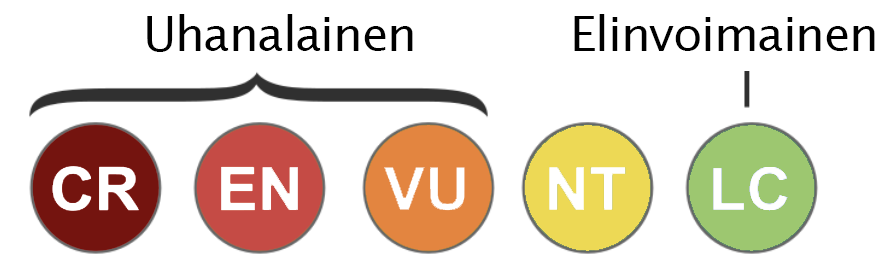
CR Critically endangered
EN Endangered
VU Endangered
NT Near threatened
LC Least concern
2019 LC - least concern
2015 LC - least concern
2010 LC - least concern
2000 LC - least concern
Regulations
Convention on International Trade in Endangered Species of Wild Flora and Fauna - CITES, Appendix II
EU regulation regarding CITES, Appendix A
Regionally Threatened 2020 - 3b Middle boreal, Northern Carelia–Kainuu
Regional assessment of threatened species 2020 has been carried out in a national assessment for species of bryophytes, vascular plants, fungi, lichens, butterflies and moths and birds classified as Least Concern (LC) and Near Threatened (NT). Species assessed as being regionally threatened are classified as RT (Regionally Threatened).