-

-
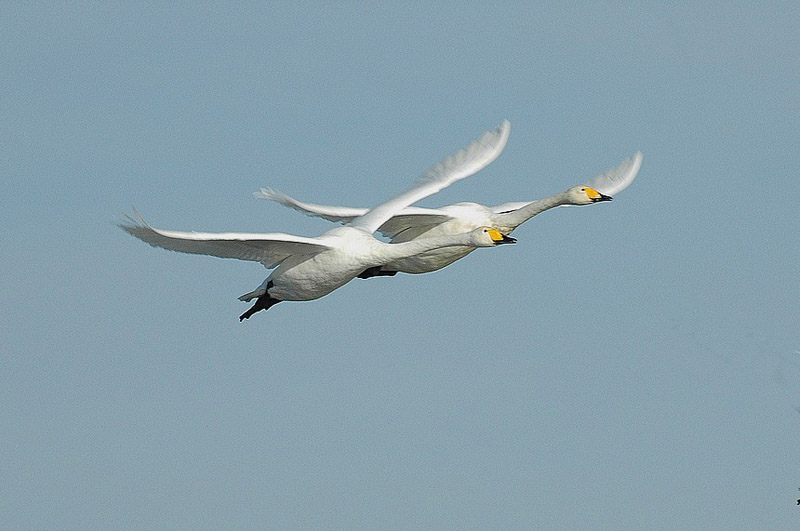
Whooper swans have a yellow bill with a black tip.

Whooper Swan
(fi: laulujoutsen, sv: sångsvan)
Cygnus cygnus
From near extinction to national symbol. This majestic white waterbird was once revered as a sacred messenger between worlds.
Identification
A large white waterbird with a long neck. Adults have a yellow bill with a black tip. When swimming, the neck is held straight, and the wings lie flat over the back. Juvenile birds are pale grey. Typical loud, trumpeting calls, that can be described as “whoop-whoop”.
Habitat
The Whooper Swan nests in various water bodies that offer shelter for nesting and are sufficiently eutrophic, such as lakes, coastal bays, and wet mires.
Nutrition
In summer, it feeds on various aquatic plants. During migration and in winter, it also forages in fields, eating fallen grains in autumn and sprouting crops in spring. It is a dabbling feeder.
Breeding
Builds large nests near water. Courtship between a swan pair can last for years before they begin raising young. The pair bond is typically lifelong.
Migration
It is a short-distance migrant. Due to global warming, the open-water season in Finland’s water bodies has become longer. Migrating swans now arrive noticeably earlier in spring and depart later in autumn than a few decades ago. An increasing number of swans remain in Finland year-round.
Distribution
Found across northern Europe and Asia. Common breeding species in Finland. In Romania, it is present only in winter. Frequent sightings in Slovenia and in Italy – its appearance remains sporadic, likely during migration or as a vagrant.
Status and conservation
Globally and in Finland Least Concern (LC). The Whooper Swan’s conservation status has improved throughout Europe. It has been on the European Union’s list of species requiring special protection since the 1970s. It nearly disappeared from Finland due to hunting and egg collection in the late 1940s. Population has recovered after decline. Now protected species in Finland.
Cultural heritage
The whooper swan, Finland’s national bird, was once considered a sacred creature living and bringing messages between the worlds of the living and the dead. Although it was later hunted nearly to extinction, it remains a powerful symbol of life, death, loyalty, and hope. Their annual return in spring was traditionally seen as a sign that all was well in the world.
Explore the factors affecting the species
Organism groups
Endangered status in Finland
ENDANGERED CATEGORY (International Union for Conservation of Nature (IUCN) classification)
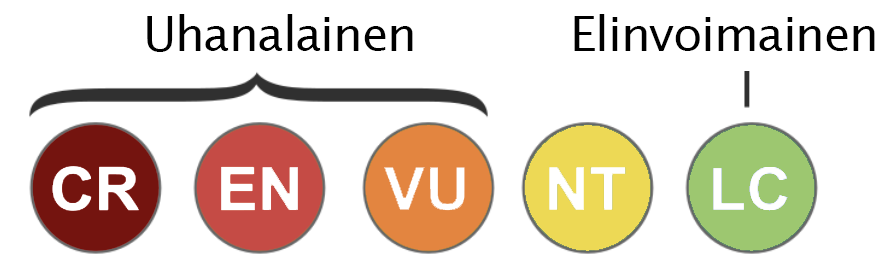
CR Critically endangered
EN Endangered
VU Endangered
NT Near threatened
LC Least concern
2019 LC - least concern
2015 LC - least concern
2010 LC - least concern
2000 LC - least concern
Regulations
EU Directive on Conservation of Wild Birds Annex I