
-

White-throated Dipper – Cinclus cinclus
Andrew2606, Eurasian White-fronted Dipper, C cinclus. Creative Commons BY-3.0
Andrew2606, Creative Commons Attribution 3.0
-
White-throated Dipper – Cinclus cinclus
Jari Laitasalo, Creative Commons Attribution Noncommercial Noderivatives 4.0
-
White-throated Dipper – Cinclus cinclus
Veli-Matti Väänänen, Creative Commons Attribution Noncommercial Noderivatives 4.0
-
White-throated Dipper – Cinclus cinclus
Veli-Matti Väänänen, Creative Commons Attribution Noncommercial Noderivatives 4.0
-
White-throated Dipper – Cinclus cinclus
Veli-Matti Väänänen, Creative Commons Attribution Noncommercial Noderivatives 4.0
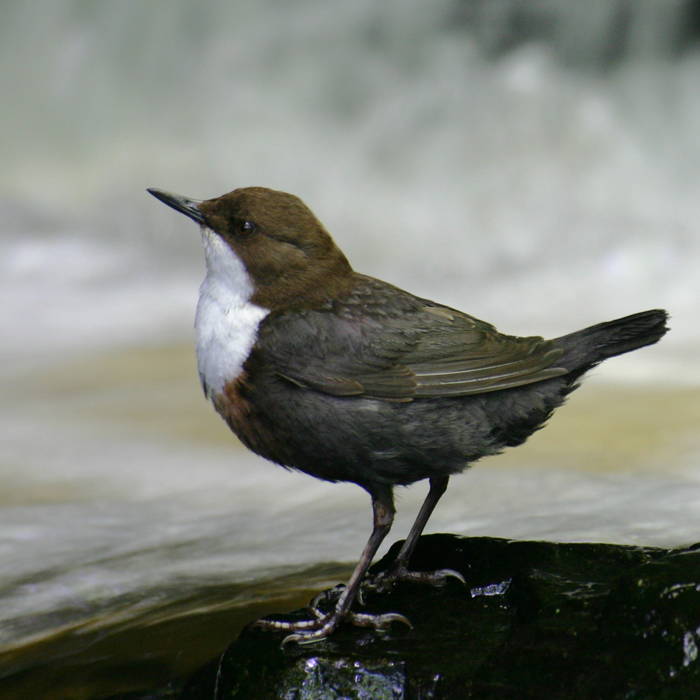


White-throated Dipper
(fi: koskikara, sv: strömstare)
Cinclus cinclus
The swift diver of mountain streams
Identification
The White-throated Dipper is distinguished by its white throat patch, which stands out against its dark grey-black plumage and brown head. It flies low against the current, skimming the water’s surface, and often pauses on rocks for long periods before diving.
Habitat
The White-throated Dipper inhabits fast-flowing, shallow streams with high water velocity and little or no aquatic vegetation, where rocky walls, large boulders, and man-made structures such as bridges, small weirs, and stone retaining walls are common.
Nutrition
Its diet is highly specialized and consists mainly of the larvae of aquatic invertebrates. It also feeds on small crustaceans, mollusks, eggs, and occasionally small fish.
Breeding
The White-throated Dipper nests in isolated pairs and builds a globular-shaped nest composed mainly of moss, with an entrance side at the bottom, in cavities, crevices or on natural or artificial supports above water (e.g. under a bridge), sometimes immediately behind a waterfall.
Migration
In Italy, the White-throated Dipper is sedentary. It leaves the territories at higher elevations when the waters freeze, moving to valley floors and foothills, occasionally to the lowlands.
Distribution
It is mainly widespread in the Alpine and pre-Alpine regions, where it is also very common.
Elsewhere, it is more localized, mainly in the hilly areas. It is absent in the lowlands, especially in the northeast.
Status and conservation
In Italy, the White-throated Dipper has an unfavorable conservation status, although its status at the European level remains favorable. The Italian population is estimated at 4,000–8,000 pairs. While numbers appear stable in central and northern Italy, the species is undergoing a marked decline in the central and southern regions, with some local extinctions already recorded.
The main threats to the species include the cementing of stream banks, sudden fluctuations in water levels during the breeding season – especially those caused by hydroelectric dam releases – and human disturbance from activities such as canoeing and fishing. Increased water acidity is also considered particularly harmful, as are the cleaning operations of artificial reservoirs during the spawning season, which can destroy the invertebrate fauna of tributaries and main watercourses.
Cultural heritage
In Celtic folklore dippers are associated with supernatural and their diving behavior relates to transition between phases of life.
Organism groups
Endangered status in Finland
ENDANGERED CATEGORY (International Union for Conservation of Nature (IUCN) classification)
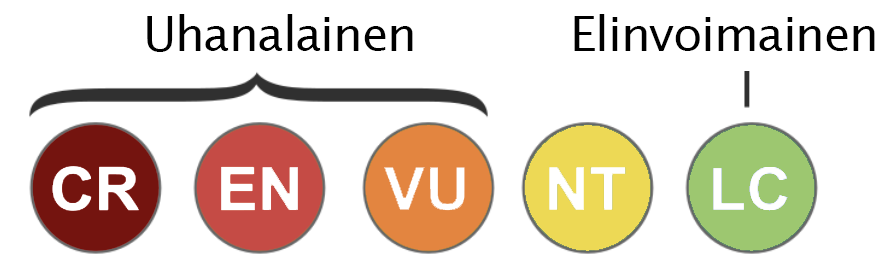
CR Critically endangered
EN Endangered
VU Endangered
NT Near threatened
LC Least concern
2019 VU - vulnerable
2015 VU - vulnerable
2010 VU - vulnerable
2000 NT - near threatened
Regulations
Threatened species (NCD 2023/1066, Appendix 6)
The Nature Conservation Decree can regulate a wild species whose natural survival in Finland has been endangered as an endangered species.
Migratory birds of the EU Birds Directive
Migratory species that occur regularly in Finland, for the protection of which must be taken similar measures to those for Annex I species (eg the establishment of Natura 2000 sites).
Safeguarding Endangered Species in Forestry – Lajiturva Project 2019–2021
OUTDATED Threatened species (NCD 1997/160, Appendix 4 2013/471)