
-

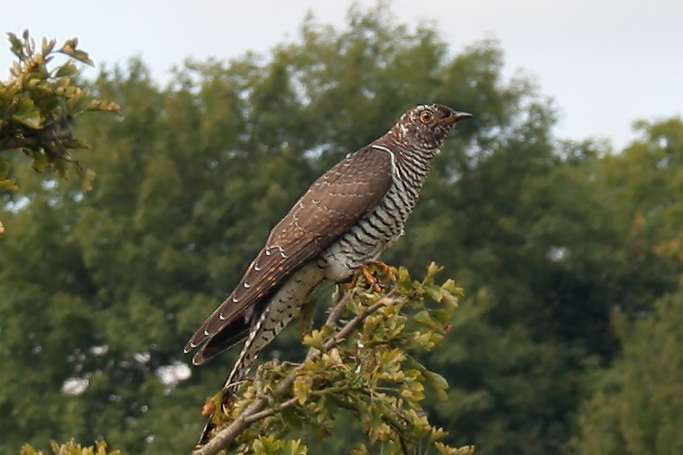
The cuckoo is rarely seen, but you can’t mistake the song of a male.
Photo Andy Morffew CC BY-SA 4.0
-
The cuckoo is a parasite. The female always lays her eggs in the nest of the same bird species in which she herself hatched.

Common Cuckoo
(fi: käki, sv: gök)
Cuculus canorus
Best known for its clear “cuckoo” call, the common cuckoo is a symbol of spring and early summer across Europe.
Identification
A medium-sized bird with a slender body, long tail and pointed wings. In flight, it resembles a small hawk. Adults occur in grey and brown colour forms, both with a pale barred underside. The male’s distinctive “cuck-oo” call is often heard long before the bird is seen.
Habitat
Occurs in forests, woodland edges, meadows, wetlands and farmland. Prefers landscapes with suitable host species whose nests can be used for breeding.
Distribution
Widespread across Europe and Asia. Found throughout Finland during the breeding season and common in much of Italy, Romania and Slovenia.
Nutrition
Feeds mainly on insects and other invertebrates, especially caterpillars, including hairy species avoided by many other birds.
Breeding
The common cuckoo is a brood parasite. The female lays its eggs in the nests of other bird species, such as redstarts, wagtails and dunnocks. The cuckoo chick is raised by the host parents and usually becomes the only chick in the nest.
Migration
A long-distance migrant that winters in tropical Africa. It returns to Europe in spring after travelling thousands of kilometres across the Mediterranean and Sahara. See Migration Atlas (Mapping EURING ringing data).
Status and conservation
Globally Least Concern (LC). The cuckoo has increased in abundance in Finland, but has declined sharply in many European countries due to habitat changes, insect declines and the effects of climate change.
Cultural heritage
One of Europe’s most important birds in folklore. Its call has long been associated with spring, good fortune and predicting the future. Across Europe, people counted the cuckoo’s calls to foretell marriage, longevity and prosperity, and the bird appears in numerous songs, legends and traditions.
Explore the factors affecting the species
Organism groups
Endangered status in Finland
ENDANGERED CATEGORY (International Union for Conservation of Nature (IUCN) classification)
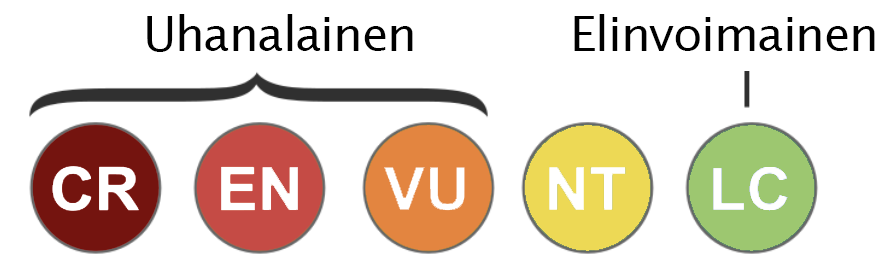
CR Critically endangered
EN Endangered
VU Endangered
NT Near threatened
LC Least concern
2019 LC - least concern
2015 LC - least concern
2010 LC - least concern
2000 NT - near threatened
Regulations
No regulations.