
-

This small tit is grey overall, with white cheeks, and a black cap and throat patch.
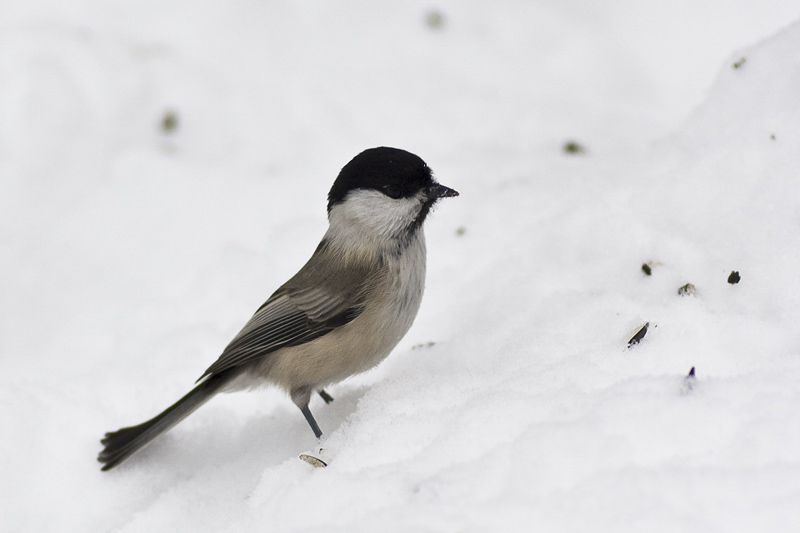
Willow Tit
(fi: hömötiainen, sv: talltita)
Poecile montanus
Once one of the most common forest birds in Finland, the willow tit has declined dramatically and is now endangered.
Identification
Smaller than the great tit, with a relatively large head and thick neck. It is grey overall, with a darker back, white cheeks, and a black cap and throat patch.
Habitat
A forest species that breeds in coniferous and mixed forests. It prefers old, mature woodland and excavates a new nesting cavity each spring in a decaying tree stump, usually birch.
Distribution
Found across northern and central Europe and parts of Asia. In Finland it occurs throughout the country, while in Italy it is mainly restricted to Alpine regions. In Romania and Slovenia it is most common in mountainous forests.
Nutrition
Feeds mainly on insects, spiders and other small invertebrates. In autumn it hides hundreds of food caches in lichens and tree bark, helping it survive the winter. It also visits bird feeders.
Breeding
The willow tit excavates its own nest cavity in soft, decaying wood, usually creating a new nest site every year. The availability of dead wood is essential for successful breeding.
Migration
A resident bird, although young birds may disperse short distances. During autumn and winter, it often forms mixed flocks with other forest birds, such as crested tits, goldcrests and treecreepers, which helps improve protection from predators.
Status and conservation
Globally classified as Least Concern (LC), but Endangered (EN) in Finland. The species has suffered a severe decline due to intensive forestry, habitat loss and the removal of dead wood needed for nesting. Fragmentation of old forests has further reduced its winter survival and breeding success.
Environmental changes and species ecology
Factors that affect the abundance and/or behavior of the species.
Explore the factors affecting the species
Organism groups
Endangered status in Finland
ENDANGERED CATEGORY (International Union for Conservation of Nature (IUCN) classification)
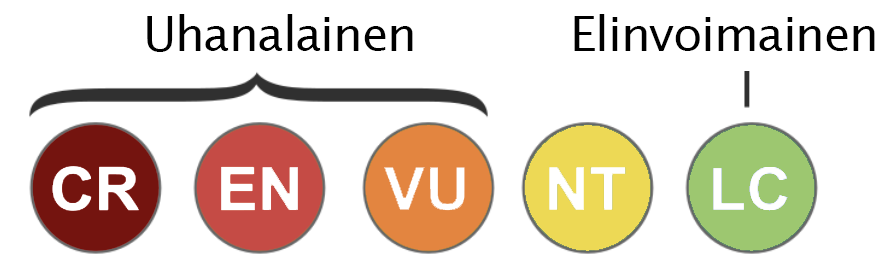
CR Critically endangered
EN Endangered
VU Endangered
NT Near threatened
LC Least concern
2019 EN - endangered
2015 VU - vulnerable
2010 LC - least concern
2000 LC - least concern
Regulations
Threatened species (NCD 2023/1066, Appendix 6)
The Nature Conservation Decree can regulate a wild species whose natural survival in Finland has been endangered as an endangered species.
Safeguarding Endangered Species in Forestry – Lajiturva Project 2019–2021