
-

Eurasian Eagle-owl – Bubo bubo
Jarkko Santaharju, Creative Commons Attribution Noncommercial Noderivatives 4.0
-
Eurasian Eagle-owl – Bubo bubo
Roland van Stokkom, Eurasian Eagle-owl, Bubo bubo, Uhu. Creative Commons BY-NC-SA-2.0
Roland van Stokkom, Creative Commons Attribution Noncommercial Share-Alike 2.0
-
Eurasian Eagle-owl – Bubo bubo
Veli-Matti Väänänen, Creative Commons Attribution Noncommercial Noderivatives 4.0
-
Eurasian Eagle-owl – Bubo bubo
Veli-Matti Väänänen, Creative Commons Attribution Noncommercial Noderivatives 4.0
-
Eurasian Eagle-owl – Bubo bubo
Veli-Matti Väänänen, Creative Commons Attribution Noncommercial Noderivatives 4.0
-
Eurasian Eagle-owl – Bubo bubo
Veli-Matti Väänänen, Creative Commons Attribution Noncommercial Noderivatives 4.0


Eurasian Eagle-owl
(fi: huuhkaja, sv: berguv)
Bubo bubo
Identification
Large owl, weighting 1.2 to 4 kg and about 70 cm long. Obvious ear tufts, orange eyes, and pale streaked underparts. It has a facial disk that helps it hear better. Listen to the it’s call by clicking the button above.
Habitat
They live in a variety of wooded habitats. More commonly found in areas with rocky outcrops and cliffs, but also in open habitats that have some trees and rocky areas like farmlands, steppes, semi-arid areas, and grasslands.
Nutrition
Active mainly at night, it hunts small mammals like voles, rats, and rabbits, but also takes birds such as woodpeckers, herons, and even other raptors. Its diet also includes amphibians, reptiles, fish, and insects.
Breeding
Eurasian Eagle-owls may be found nesting on ledges, in cave entrances, and within rock crevices on cliffs. They also sometimes use the abandoned nests of other large birds, such as ravens or eagles. The same site is often used for several years or in rotation with other favoured sites.
Migration
Non migrant species.
Distribution
Eurasian Eagle-owls are widely distributed across Europe, from Spain to Russia, and extend through much of Asia to China and the Middle East. They are also found in parts of North Africa, mainly in suitable rocky and forested habitats.
Status and conservation
IUCN status is Least Concern. In the past, the main threats were hunting and poisoning, while today the biggest risks include disturbance of nesting sites from human activities such as mountaineering, as well as electrocution and collisions with vehicles.
Cultural heritage
In Slovenia, Romania, Italy, and Finland the eagle owl is linked to wisdom, prophecy, and death omens. It appears in folklore, myths, and stories as a guide, protector, or feared night bird connected to the spirit world and mystery. Read more details from the booklet.
Organism groups
Endangered status in Finland
ENDANGERED CATEGORY (International Union for Conservation of Nature (IUCN) classification)
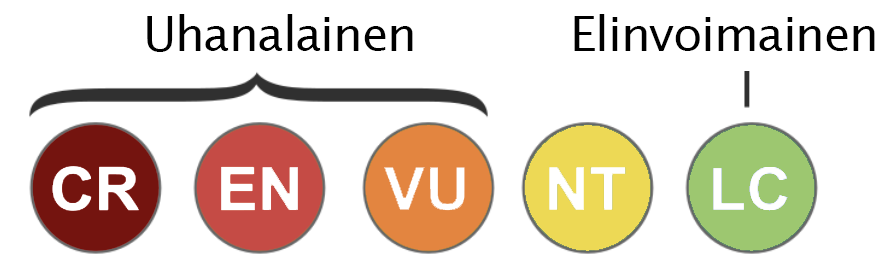
CR Critically endangered
EN Endangered
VU Endangered
NT Near threatened
LC Least concern
2019 EN - endangered
2015 EN - endangered
2010 NT - near threatened
2000 LC - least concern
Regulations
Threatened species (NCD 2023/1066, Appendix 6)
The Nature Conservation Decree can regulate a wild species whose natural survival in Finland has been endangered as an endangered species.
EU Directive on Conservation of Wild Birds Annex I
Convention on International Trade in Endangered Species of Wild Flora and Fauna - CITES, Appendix II
EU regulation regarding CITES, Appendix A
Safeguarding Endangered Species in Forestry – Lajiturva Project 2019–2021
Species used in the automatic procedure for forest use notifications (MKI-OHKE 2023)