

ENGAGEMENT
Embodying sustainability values
Working in a school or other educational institution necessitates balancing multiple – and sometimes mutually contradictory – values, objectives and understandings. As a result, translating values and ideals into pedagogical practice can be challenging, often leading to ongoing compromises and a continuation of business-as-usual. Successfully promoting sustainability requires prioritisation, inclusive collaboration and a solid foundation of knowledge about sustainability and nature.
Practitioners consider engagement to be one of the most important factors in promoting sustainability in education. Engagement with sustainability in schools and universities arises through values, participation and nature.
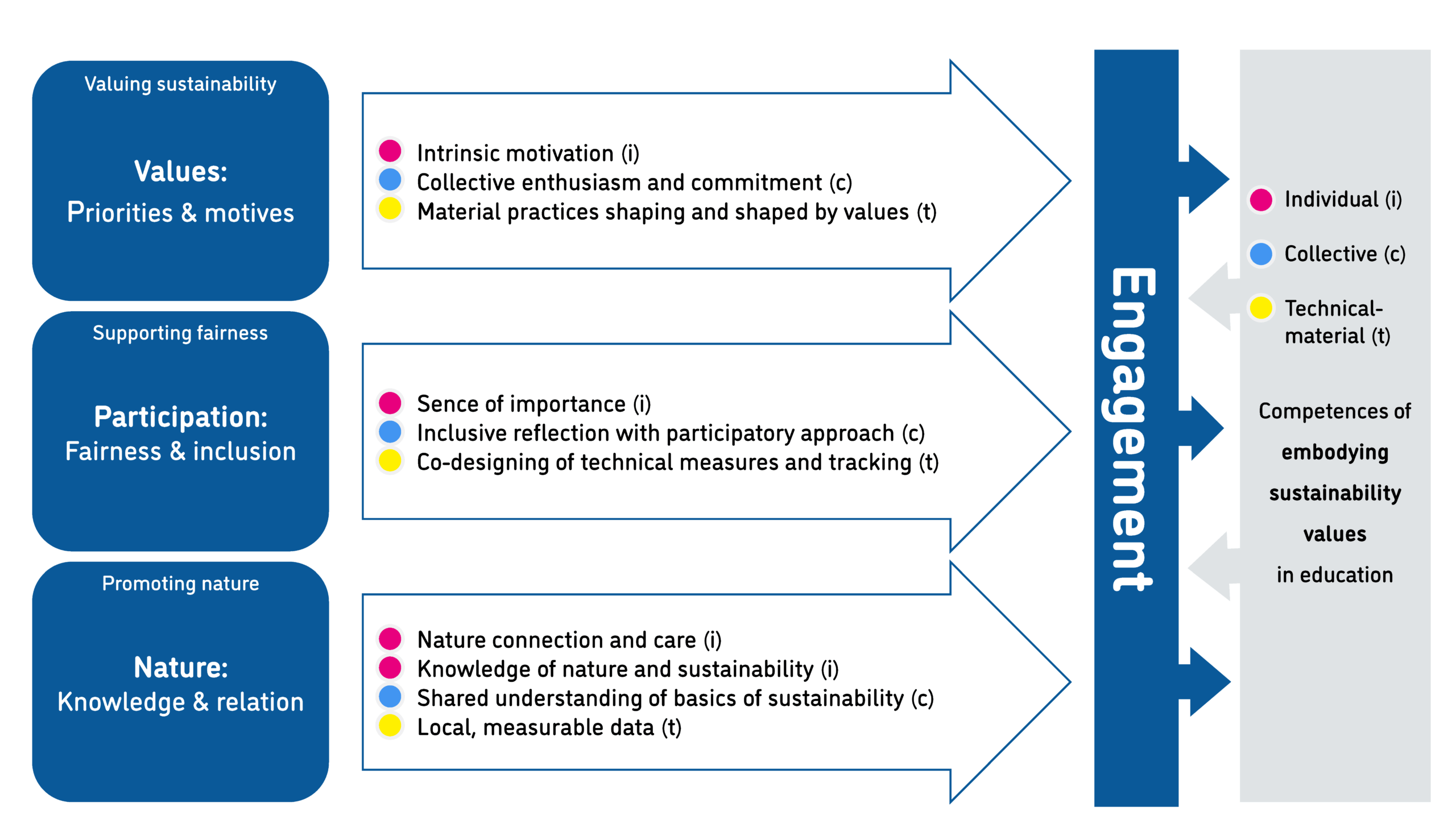





Values reflect priorities and motives
The intrinsic motivation of individuals, collective enthusiasm and material practices – shaped by and shaping pro-sustainability values – enable engagement.
To reflect on personal values; identify and explain how values vary among people and over time, while critically evaluating how they align with sustainability values.
- Valuing sustainability aims to foster reflection on values and perspectives in relation to concerns for sustainability. In this context, learners can articulate their values and consider their alignment with sustainability as the common goal.
- Valuing sustainability could be defined as a metacompetence, since its primary aim is not to teach specific values, but make learners realise that values are constructs and people can choose which values to prioritise in their lives.
- Valuing sustainability enables learners to reflect on their way of thinking, their plans, and their actions. It asks them whether these cause any harm and are in line with sustainability values and thus contribute to sustainability. It offers learners an opportunity to discuss and reflect on values, their variety and culture-dependence.
Read more from the GreenComp document that EU have published and where the direct quotes of this GreenComp section are copied.
Knowledge
Knows the main views on sustainability: anthropocentrism (human-centric), technocentrism (technological solutions to ecological problems) and ecocentrism (nature-centred), and how they influence assumptions and arguments.
Knows the main values and principles underpinning socio-economic models and their relation to sustainability.
Knows that values and principles influence action that can damage, does not harm, restores or regenerates the environment.
Knows that various cultures and generations may attach more or less importance to sustainability depending on their value systems.
Knows that when human demand for resources is driven by greed, indifference and unfettered individualism, this has negative consequences for the environment.
Knows how one’s position in society influences personal values.
Skills
Can critically assess and compare underlying sustainability values and principles in arguments, action, policies and political claims.
Can evaluate issues and action based on sustainability values and principles.
Can bring personal choices and action in line with sustainability values and principles.
Can articulate and negotiate sustainability values, principles and objectives while recognising different viewpoints.
Can identify and include values of communities, including minorities, in problem framing and decision making on sustainability.
Attitudes
Is prone to acting in line with values and principles for sustainability.
Is willing to share and clarify views on sustainability values.
Is open-minded to others and their world-views.
Is ready to critique and value various cultural contexts depending on their impact on sustainability.
- Personal value reflection and self-examination and willingness to open dialogue (i)

- Acting as a role model and a peer influence (i)
- Respectful and inclusive value discussions in a safe space, collectively identifying the values underlying different conceptions of sustainability (c)
- Allocating time, space, and other resources (c)
- Recognising and reflecting on the collective values embedded in regulations, curricula, decisions and practices (c) and the material environment (t)
- Mutually shared internal (students and staff) and external (stakeholders) rules for action (c)


Creating or strengthening:
-
-
-
-
-
-
-
-
- (i)=individual competence
- (c)= collective competence
- (t)= technical-material competence
- (i)=individual competence
-
-
-
-
-
-
-
- Organisational specificities and scarce resources limiting possibilities (c)
- Conflicting values, competing priorities (academic, consumerist, economic) (i)
- Inconsistency in examples and support provided by administration, teachers, and parents (c)
- Belonging to identity groups that are indifferent to sustainability (c)
- Low motivation and personal commitment, and seeing sustainability activities as extra tasks (i)
- Lack of competence and willingness to promote, facilitate and take part in value discussion (i)
Creating or strengthening:
-
-
-
-
-
-
-
-
- (i)=individual competence
- (c)= collective competence
- (t)= technical-material competence
- (i)=individual competence
-
-
-
-
-
-
-
- Where and when could meaningful discussions on sustainability values be organised? Who could be in charge of them?
- How can I help my team/students staff feel safe to express differing views on sustainability topics? What norms or agreements help to maintain inclusivity in sustainability-related dialogue?
- How do you understand the meaning of sustainability? Are there diverse understandings in your class/team/group? How could each of these understandings promote sustainability?
- What kind of role model are you for your peers, students or staff. To promote sustainability, how could you demonstrate sustainability values?
- Analyse in a group: What kind of values are embedded in the technical-material environment, practices and documents of the school?
Participation includes the perspectives of fairness and inclusion
Participation that fosters engagement requires a personal sense of importance, inclusive critical reflection and a participatory approach within the educational community, and co-design of technical measures and environmental impact tracking.
To support equity and justice for current and future generations and learn from previous generations for sustainability.
- Supporting fairness is about promoting equity and justice among present and future generations, while learning from past traditions and actions. Starting from the premise that human health is intrinsically linked to planetary health, this competence can help learners understand that environmental quality is linked to equity and justice. Access to green spaces can reduce health-related socio-economic inequalities. Environmental equity and justice imply, therefore, human equity and justice.
- Yet supporting fairness is not only about promoting environmental justice and equity to improve human health. In line with the competence ‘promoting nature’, supporting fairness is also about taking into account the interests and capabilities of other species and environmental ecosystems, as well as the importance of preserving nature for future generations and for nature itself. Supporting fairness as a competence can be fostered
by promoting responsibility in collaborative activities and teamwork, while acknowledging and respecting other view points.
Read more from the GreenComp document that EU have published and where the direct quotes of this GreenComp section are copied.
Knowledge
Knows that ethical concepts and justice for current and future generations are related to protecting nature.
Knows about environmental justice, namely considering the interests and capabilities of other species and environmental ecosystems.
Knows the importance of preserving nature for future generations for its own sake.
Knows that individuals and communities differ in how and how much they can promote sustainability.
Skills
Can apply equity and justice for current and future generations as criteria for environmental preservation and the use of natural resources.
Can assess and question personal needs to carefully manage resources in the pursuit of longer-term goals and common interests.
Can respect, understand and appreciate various cultures in relation to sustainability, including minority cultures, local and indigenous traditions and knowledge systems.
Can help build consensus on sustainability in an inclusive manner.
Attitudes
Is committed to decreasing material consumption.
Has a sense of belonging to a common humanity and of solidarity with future generations.
Is committed to respecting the interests of future generations.
- Well-designed, sufficiently resourced, inclusive participatory process with strong pedagogical leadership and shared decision making (c)
- Creating collaborative, inclusive and accessible learning environments that make respectful dialogues possible (c)
- Integrating sustainability in lesson plans and curricula, with interdisciplinary or transdisciplinary strategies (c)
- Clear communication and promotion of creative options to engage in sustainability efforts, making voluntary participation easy (c)
- Giving an example of personal passion, taking advantage of peer influence (i)
- Co-designing technical measures (t)
- Assigning environmental responsibilities (t)
Creating or strengthening:
-
-
-
-
-
-
-
-
- (i)=individual competence
- (c)= collective competence
- (t)= technical-material competence
- (i)=individual competence
-
-
-
-
-
-
-
- Apathy, lack of incentives or recognition for participation, and limited motivation, skills (i) or possibilities for cooperation (c)
- Limited time for engagement processes (c)
- Hierarchical organisation (c)
- Poor facilitation of participatory processes: Limited competence and insufficient support (i)
- Lack of integration into everyday practices or strategies (c)
- Narrow understandings of sustainability, causing persistent disputes (i)
Creating or strengthening:
-
-
-
-
-
-
-
-
- (i)=individual competence
- (c)= collective competence
- (t)= technical-material competence
- (i)=individual competence
-
-
-
-
-
-
-
- What kind of pedagogical leadership is needed from managers to guide sustainability efforts effectively and using a participatory approach?
- Who are the key internal and external stakeholders that can support sustainability in our school? How to reach them and build partnerships that strengthen sustainability?
- What kinds of environmental responsibilities can be meaningfully assigned to students or teachers in our school/university? How can these responsibilities be integrated into everyday learning and school culture?
- What kinds of physical spaces or environments do we have that could help in participatory and hands-on learning?
- Are there individuals or groups in our community whose voice is seldom heard? Who? How could we ensure that all feel heard and valued?
- How can I embed sustainability themes across different subjects using interdisciplinary or transdisciplinary approaches, engaging all students?
Nature as a perspective refers to knowledge and relations
Engagement grows from a personal connection with nature and a caring attitude, knowledge of nature, ecology and sustainability sciences, a collective understanding of the basics of sustainability, and access to local, measurable data. Understanding relations between humans, nature and the human-made environment is essential.
To acknowledge that humans are part of nature; and to respect the needs and rights of other species and of nature itself in order to restore and regenerate healthy and resilient ecosystems.
- Promoting nature is about developing empathy towards the planet and showing care for other species. This requires knowledge about the main parts of the natural environment (geosphere, biosphere, hydrosphere, cryosphere and atmosphere) and the close links and interdependence between living organisms and non-living components. Knowledge about naturalmphenomena can spur us on to more closelymconnect with nature, which in turn can motivate further learning for sustainability. Promoting nature fosters a healthy relationship with the natural environment and aims to ignite in people a feeling of connectedness that can help contrast the psychological distress and negative emotions that children and young people worldwide experience because of climate change and can help improve their mood and mental health.
- The ‘nature deficit disorder’ conveys the human costs of alienation from nature:
- i) decreased use of
the senses, - ii) attention difficulties,
- iii) higher ratesof physical and emotional illnesses,
- iv) a rising rate of myopia,
- v) increased child and adult obesity, and
- vi) increased vitamin D deficiency.
- i) decreased use of
- Research indicates that to overcome the ‘nature deficit disorder’ not only do we need to be in contact with nature, but we also need to feel connected to nature. While the former involves physical interaction with the natural environment mainly at surface level, the latter concerns our feelings and views resulting from meaningful relationships being developed and the internalisation of our experiences in the natural environment, e.g. with animals, plants or places. Such internalisation can, in the long term, promote restoration of nature.
Read more from the GreenComp document that EU have published and where the direct quotes of this GreenComp section are copied.
Knowledge
Knows about the main parts of the natural environment (geosphere, biosphere, hydrosphere, cryosphere and atmosphere) and that living organisms and non-living components are closely linked and depend on each other.
Knows that our wellbeing, health and security depend on the wellbeing of nature.
Knows that people are part of nature and that the divide between human and ecological systems is arbitrary.
Knows that humans shape ecosystems and that human activities can rapidly and irreversibly damage ecosystems.
Knows that damaging and exhausting natural resources can lead to disasters and conflicts (e.g. loss of biodiversity, draughts, mass migration and war).
Knows about the need to decouple production from natural resources and wellbeing from consumption.
Skills
Can assess own impact on nature and consider the protection of nature an essential task for every individual.
Can see and imagine humans living together and respecting other life forms.
Can acknowledge cultural diversity within planetary limits.
Can find opportunities to spend time in nature and helps to restore it.
Can identify processes or action that avoid or reduce the use of natural resources.
Attitudes
Cares about a harmonious relationship existing between nature and humans.
Is critical towards the notion that humans are more important than other life forms.
Shows empathy with all life forms.
Is appreciative of nature’s role in our wellbeing, health and security.
Continuously strives to restore nature.
- Versatile learning methods (i)
- Incorporating sustainability in every discipline (c)
- Designing elective courses and multidisciplinary learning modules on sustainability (c)
- Encouraging students towards sustainability and examining how everyday choices influence wider society (from curiosity to advocacy) (i)
- Sharing systematic knowledge and a clear baseline of facts among students, teachers and technical staff (i)
- Peers reminding each other to promote sustainability (i)
- Local technical solutions and environments used as teaching aids (t)
- Offering a solid grasp of environmental and systemic knowledge (i), for example for understanding how solar arrays interact with the grid or how municipal waste is handled after collection. (t)
Creating or strengthening:
-
-
-
-
-
-
-
-
- (i)=individual competence
- (c)= collective competence
- (t)= technical-material competence
- (i)=individual competence
-
-
-
-
-
-
-
- Distrust of research (i)
- Pedagogical incompetence (i)
- Teachers’ inconsistent (weak) role-modelling (i)
- Other learning contents prioritised (i)
- Academic requirements focus on other things (c)
Creating or strengthening:
-
-
-
-
-
-
-
-
- (i)=individual competence
- (c)= collective competence
- (t)= technical-material competence
- (i)=individual competence
-
-
-
-
-
-
-
- What opportunities exist to co-create elective or multidisciplinary courses focused on sustainability? How can I collaborate with colleagues from other disciplines?
- What nearby technical-material resources (e.g. energy systems, water use, waste management) can serve as real-world teaching tools?
- How can sustainability be meaningfully integrated into my subject area?
- How could you organise an awareness-raising campaign on the basics of sustainability in your school or university? In what course or situation? With whom?
- Reflect in group: How are your everyday choices connected to broader sustainability issues?
- What kind of practices could encourage students to support and remind each other about sustainability?
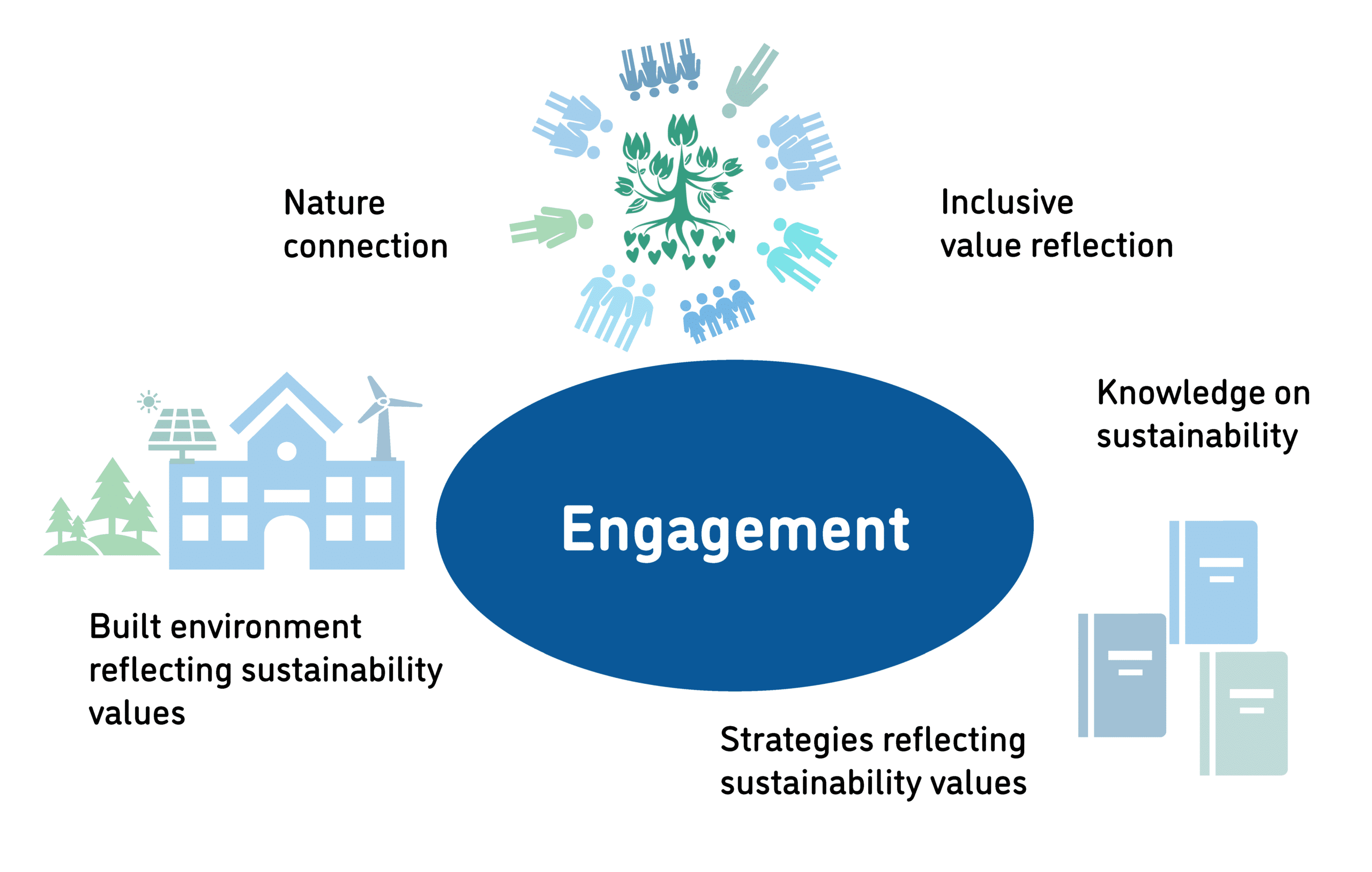
Value reflection, inclusive discussions, nature connection, knowledge about sustainability, and technical-material environments and strategies that reflect sustainability values enable engagement.
Stories about Engagement from the ECF4CLIM project schools and universities
-

Plastic pollution of the banks of the Danube
International Danube River Day, celebrated annually on June 29, is an opportunity to celebrate this important river and to promote its conservation and the environment. In 2023, we participated in a trip with primary school students to a bank of the Danube to spend time in nature. We found a lot of rubbish. The children exclaimed: We don’t like it here? Why is it like this? Who should clean it? The general feeling was one of dissatisfaction. After this experience, in the classroom the teacher talked about many aspects of plastic pollution: causes, effects and solutions. In the following spring of 2024, the children happily participated in helping clean the Danube bank of plastic.
-written by a Romanian teacher
-
Enthusiasm spread from individual initiatives to collective action
Read more: What helped them and what can we learnIn one Spanish school, the principal noticed and seized the opportunity to act as part of the Eco-Schools network and receive support from the ECF4CLIM project for the development of environmental activities. The school received help from many organisations. Together, with support from organisations like CIEMAT, ARBA, Ecoescuelas and CENEAM, they learned about clean energy, recycling, biodiversity conservation, how to save water, trees, forests and how nature is important. They understood better what and why actions for sustainability are important.
-
Headmasters and teachers as enablers of engagement
Read moreBoth headmasters and teachers play a key role in engaging the whole school, fostering students’ interest and engagement in sustainability actions. This was noted in all the partner countries.
“A school is like its leaders.” – A Finnish principal
“Dear teacher, be brave!” –Teachers from Juhannuskylä School, Finland
-
Portuguese schools and practical activities
Read moreAt the Portuguese demonstration sites, engagement was achieved by actively involving students, teachers and the broader community in practical sustainability activities rather than focusing on theoretical discussions.
-
Collected short examples from all countries
Read short examplesDuring the ECF4CLIM project, many examples of importance of engagement were noticed in different project countries.

Engagement and competences
To translate Engagement into practical actions, we should consider three spheres:
- Educating individual students, teachers, headmasters and other staff members to broaden their knowledge, skills and attitudes, enabling them to engage personally in sustainability efforts;
- Focusing on collective regulations, norms, practices and organisational culture to strengthen the engagement of the entire school or university; and
- Developing the technical-material environment to engage the institution in sustainable best practices.
The individual, collective and technical-material possibilities are intertwined, with each area enabled by the other two.
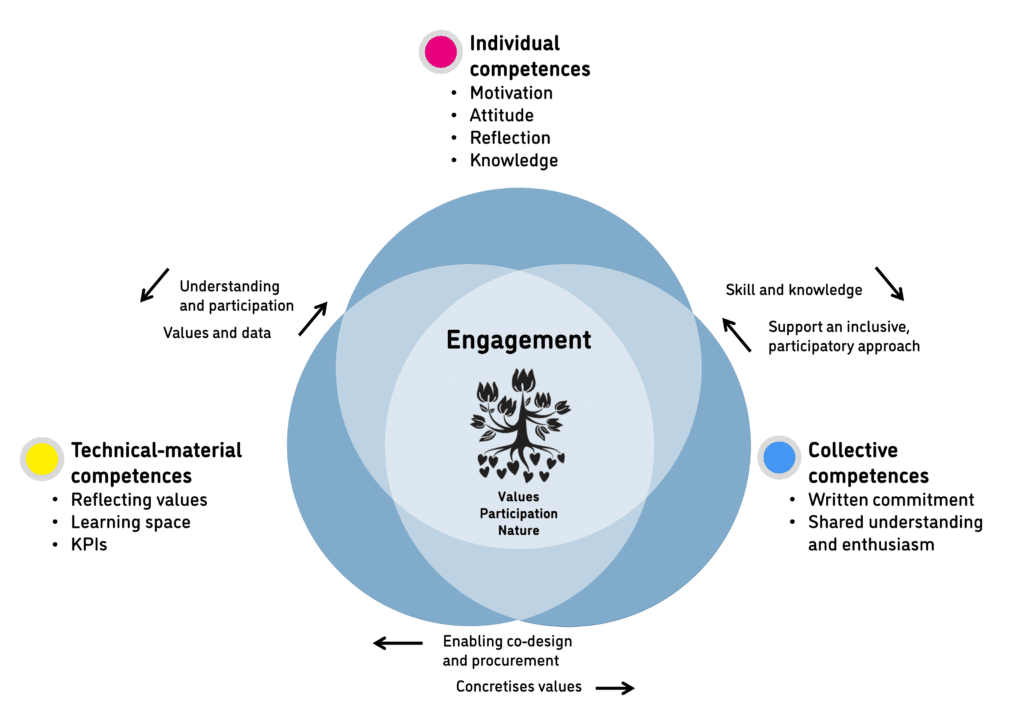
Individual attitudes, knowledge and skills driving engagement
Attitudes and the intrinsic motivation of students, teachers, managers, other staff and stakeholders facilitates engagement with sustainability efforts. A positive and caring attitude toward nature – including humans – can be fostered through experiences and knowledge about nature and sustainability. Reflecting on fairness and inclusiveness, both individually and in groups, is an effective way to go forward. Skills in self-examination and reflection on the potential of different value profiles[1] to support engagement with sustainability are also essential. The ability to question the system and to rethink our ways of being in the world are important competences; however, in educational practice, they may receive too little attention.
Collective competences reflecting the engagement of the entire school
Formal commitment to sustainability is embedded in regulations and norms. Despite the gap between bold ambitions and actual practice, legislation, plans and strategies provide support for local sustainability efforts. For shared engagement, the cultural-cognitive level is essential. Collective enthusiasm fosters the engagement of the whole school or university. Underpinning sustainability work is a shared understanding of the fundamentals of environmental science.
Sustainability values materialise in technical-material competences
Technical-material competences reflect engagement in sustainability at schools and universities. These competences include infrastructure, equipment and learning environments. Improving technical-material competences leads to short-term environmental gains. Measuring water and energy use, the amount of recycled waste, or calculating other key performance indicators that describe the environmental impact, provides concrete data on progress and the technical-material state of engagement within a school or university. Natural and built environments also serve as important learning spaces.
Individual, collective, and technical-material competences are deeply intertwined
Individual, collective and technical-material competences related to engagement are deeply intertwined. For example, the technical-material environment offers local data for collective discussions and constructing practical knowledge – that is, individual competences. Easy-to-understand numbers foster a sense of achievement and show participants that their efforts pay off, which in turn increases motivation and broadens participation. Technical-material competences promote sustainability values among students and staff through their very existence. Individual competences, in turn, are essential for understanding the basics of environmental impact and for utilising participatory opportunities in technical-material design.
Collective competences such as regulations, practices and resources are essential enablers in co-designing technical-material environments and procurement. Procurement and technical-material competences, in turn, reveal the materialised values of the institution and offer a window into how written strategies are translated into reality. They can increase the enthusiasm and participation of the entire school or university in the development and promotion of sustainability.
Collective competences such as structures, decisions, plans and resources are also important for supporting an inclusive, participatory approach, which in turn helps develop individual competences. To promote these collective competences, principals and teachers should possess individual competences, such as sustainability knowledge and decision-making skills, as well as the ability to facilitate collective value reflection and foster inclusive dialogue. Engagement skills should range from cross-boundary teamwork to meticulous micro-planning and strong cooperation abilities for working with stakeholders.