GREENCOMP
and
THE ROADMAP FOR
SUSTAINABILITY COMPETENCES
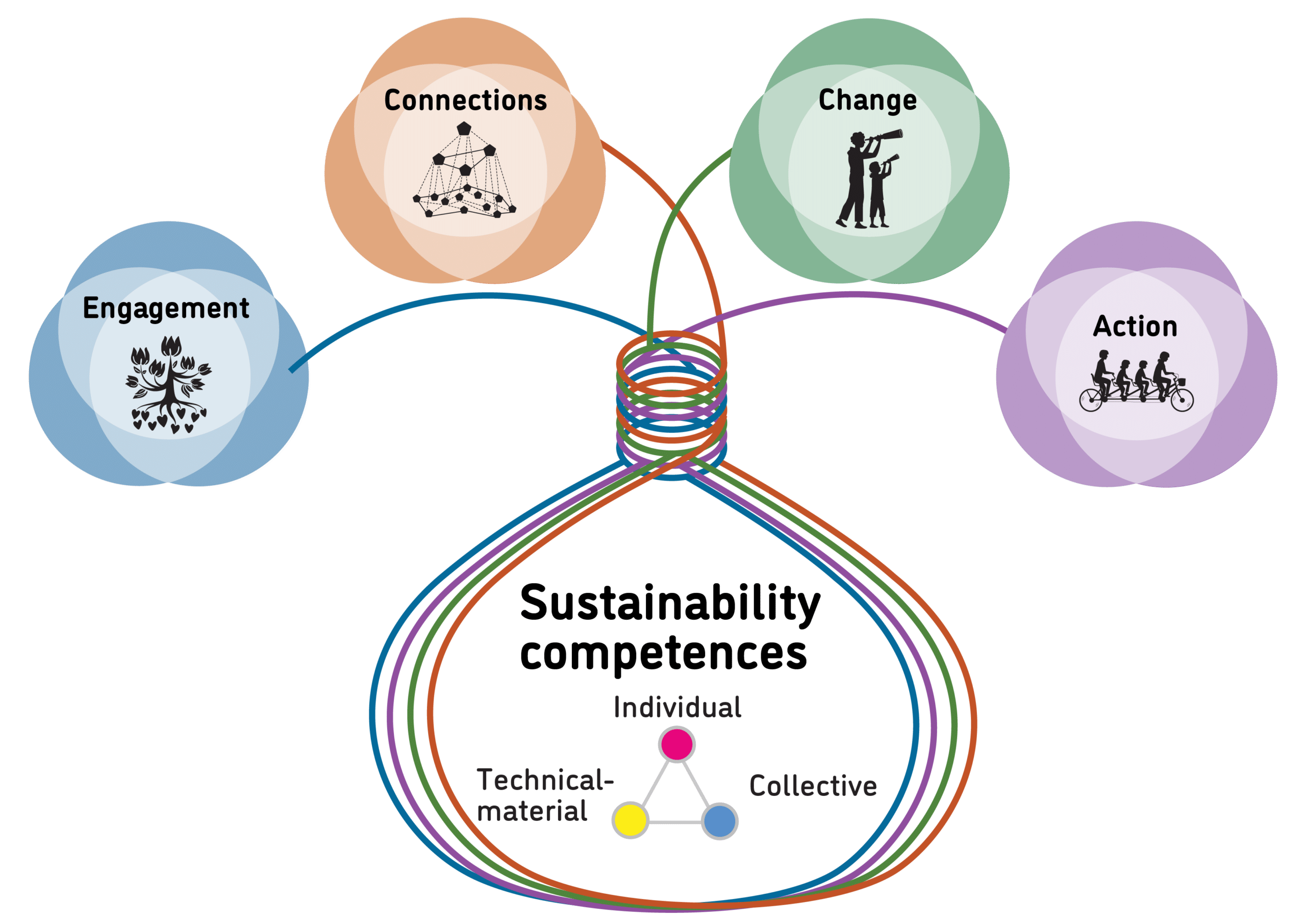
This Roadmap for Sustainability Competences outlines the key drivers for sustainability competences in educational practice. Its goal is to empower educational communities to take action against climate change and promote sustainability.
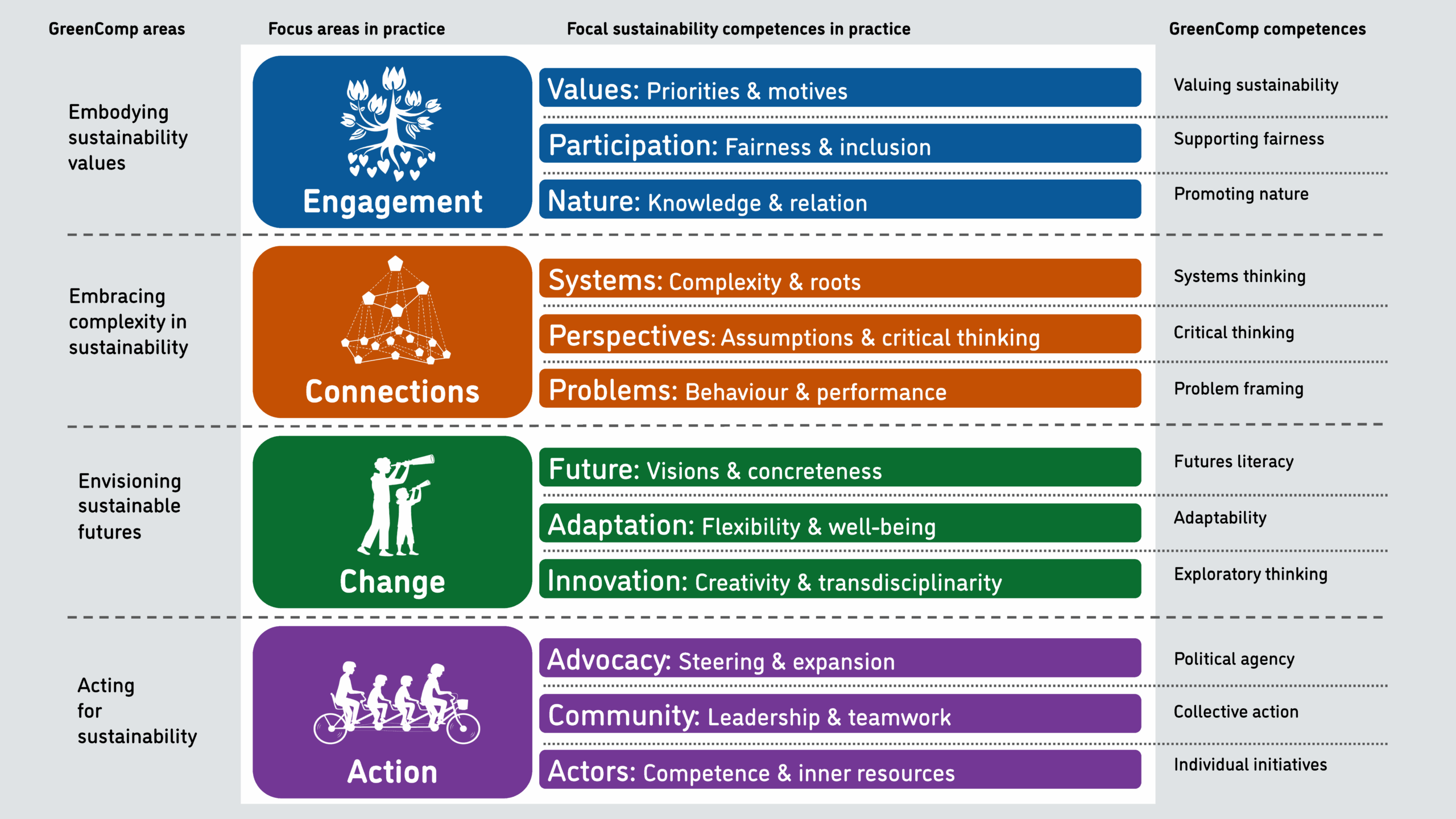
This Roadmap uses GreenComp as a springboard. It elaborates on competences through four key focus areas that are important for promoting sustainability in educational practices: Engagement – further elaborating in practice the GreenComp competence area Embodying sustainability values; Connections – further elaborating in practice the GreenComp competence area Embracing complexity in sustainability; Change – further elaborating in practice the GreenComp competence area Envisioning sustainable futures, and Action – further elaborating in practice the GreenComp competence area Acting for sustainability.


What are sustainability competences?
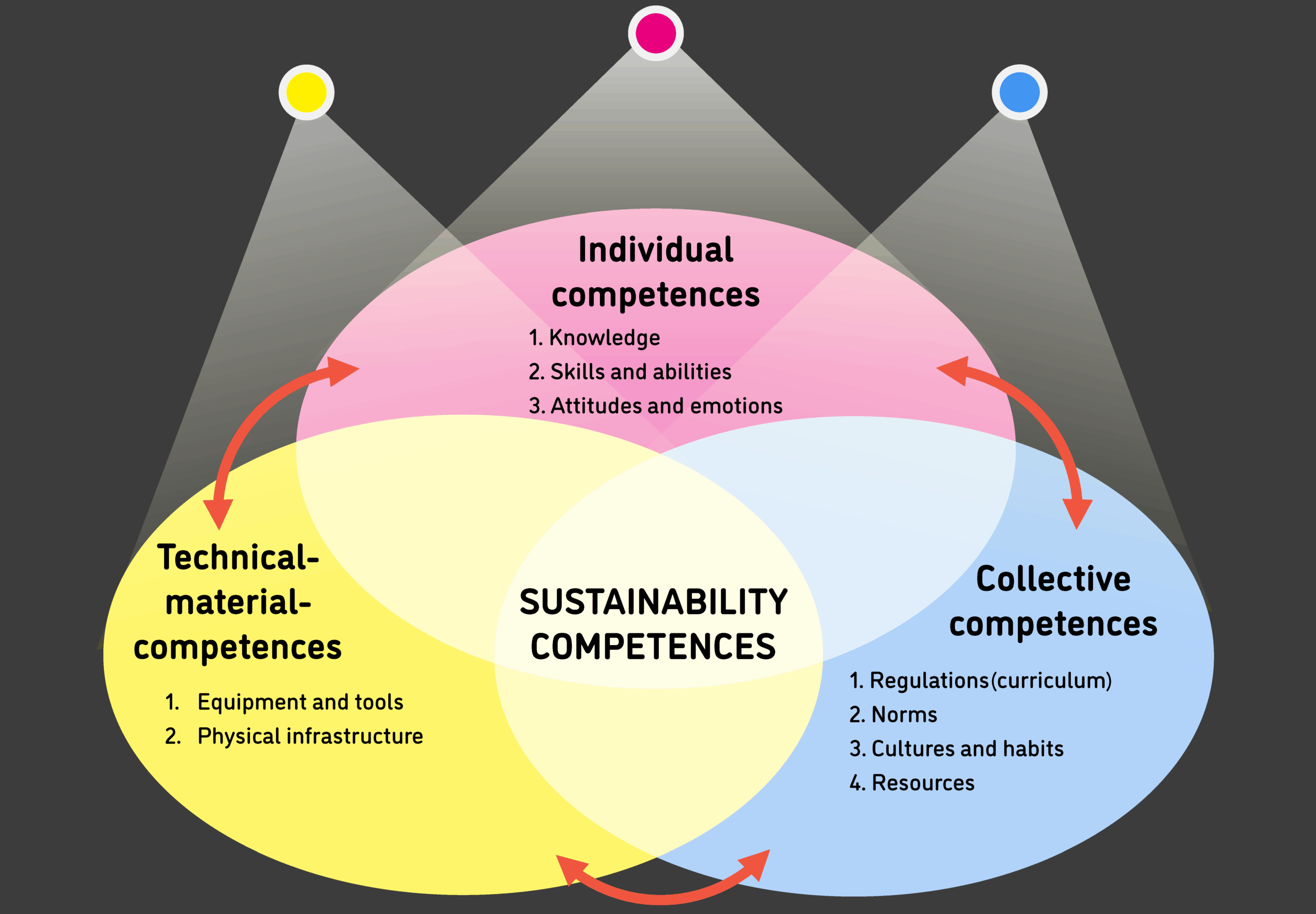
We understand sustainability competences as the ability to act for sustainability. One essential starting point for this Roadmap was the European sustainability competence framework, GreenComp, which was published in the same spring that the ECF4CLIM project began. This Roadmap expands on the ideas presented in GreenComp: while GreenComp focuses primarily on describing individual-level knowledge, skills and attitudes, this Roadmap broadens the concept of competences from an individual perspective to the spheres of collective competences and technical-material competences.
- By individual sustainability competences, we mean the knowledge, skills and attitudes that enable individuals to act for sustainability.
- By collective sustainability competences, we refer to the regulations, norms and cultural-cognitive capacities of an organisation that support sustainability action.
- By technical-material sustainability competences, we refer to the equipment, infrastructure and natural environment that enable or support sustainability efforts.
You can learn more about the theoretical backgrounds and methods of designing this Roadmap from the Roadmap for Sustainability Competences document.

Roadmap as a framework
This Roadmap can serve as a framework to structure and understand situations across different scales of educational settings.
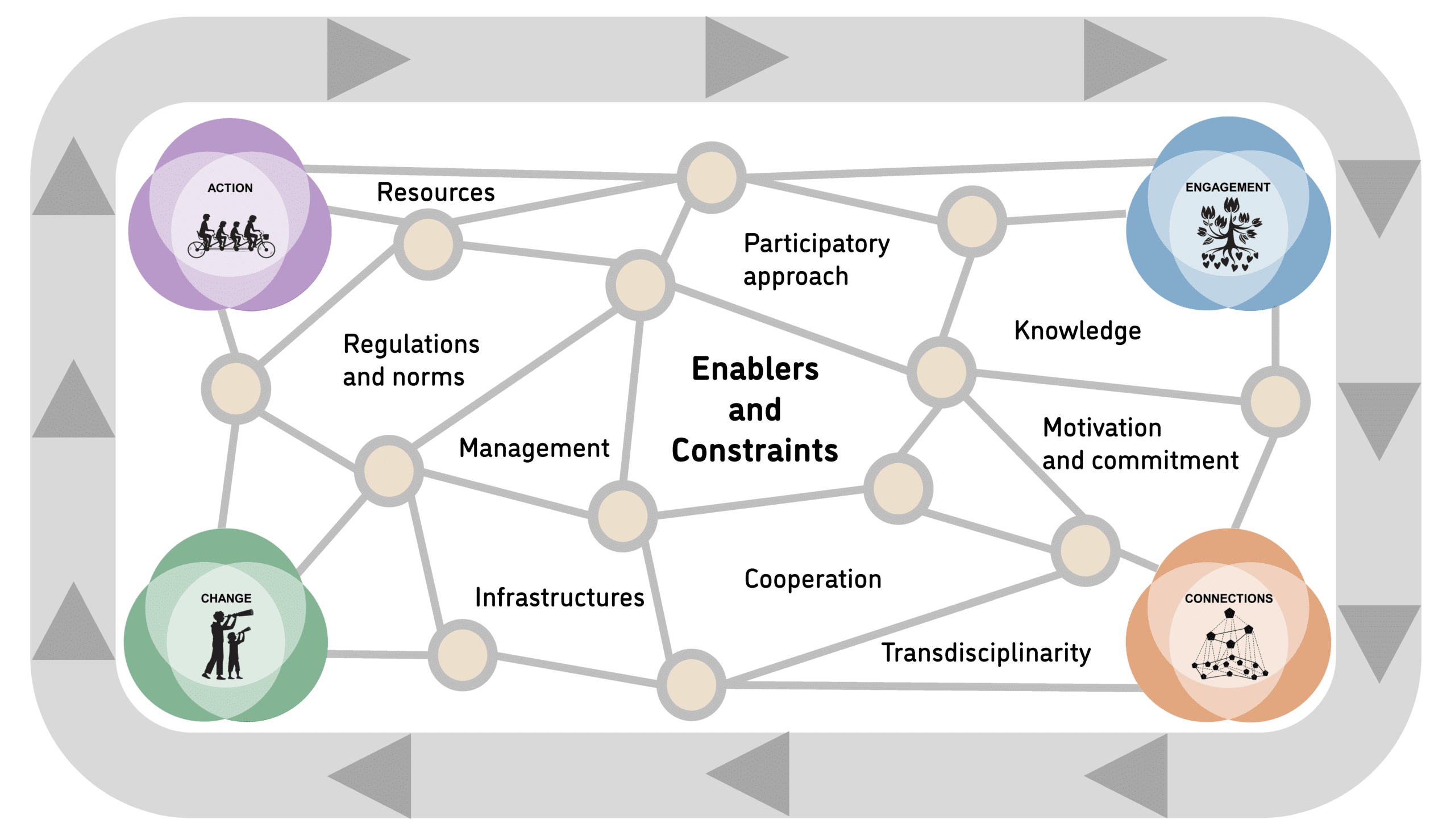
- Am I ensuring that engagement is promoted in this exercise or lecture?
- Am I highlighting connections between the content and sustainability?
- What change in current practices, related to the contents of this learning session, is needed for a sustainable future?
- What kinds of action could be included in the lesson?
- How could sustainability be integrated into this course?
- What values does this course reflect?
- How is this subject or course connected to sustainability?
- What kinds of solutions does it offer?
- How can this course contribute to action toward sustainability?
- Are we ensuring engagement with sustainability?
- Where and how do we address connections to sustainability?
- What changes are needed in our institution?
- How can we implement these changes in practice?
- Are educational institutions actively engaged in sustainability?
- What are the connections to other fields of administration?
- What kind of changes are needed to make education an effective driver of sustainability?
- What sustainability actions are needed in administration, and what are their enablers and barriers?

Roadmap as a process
We can also consider this Roadmap for Sustainability Competences as a process. The process toward developing sustainability competences in education progresses through four main phases.
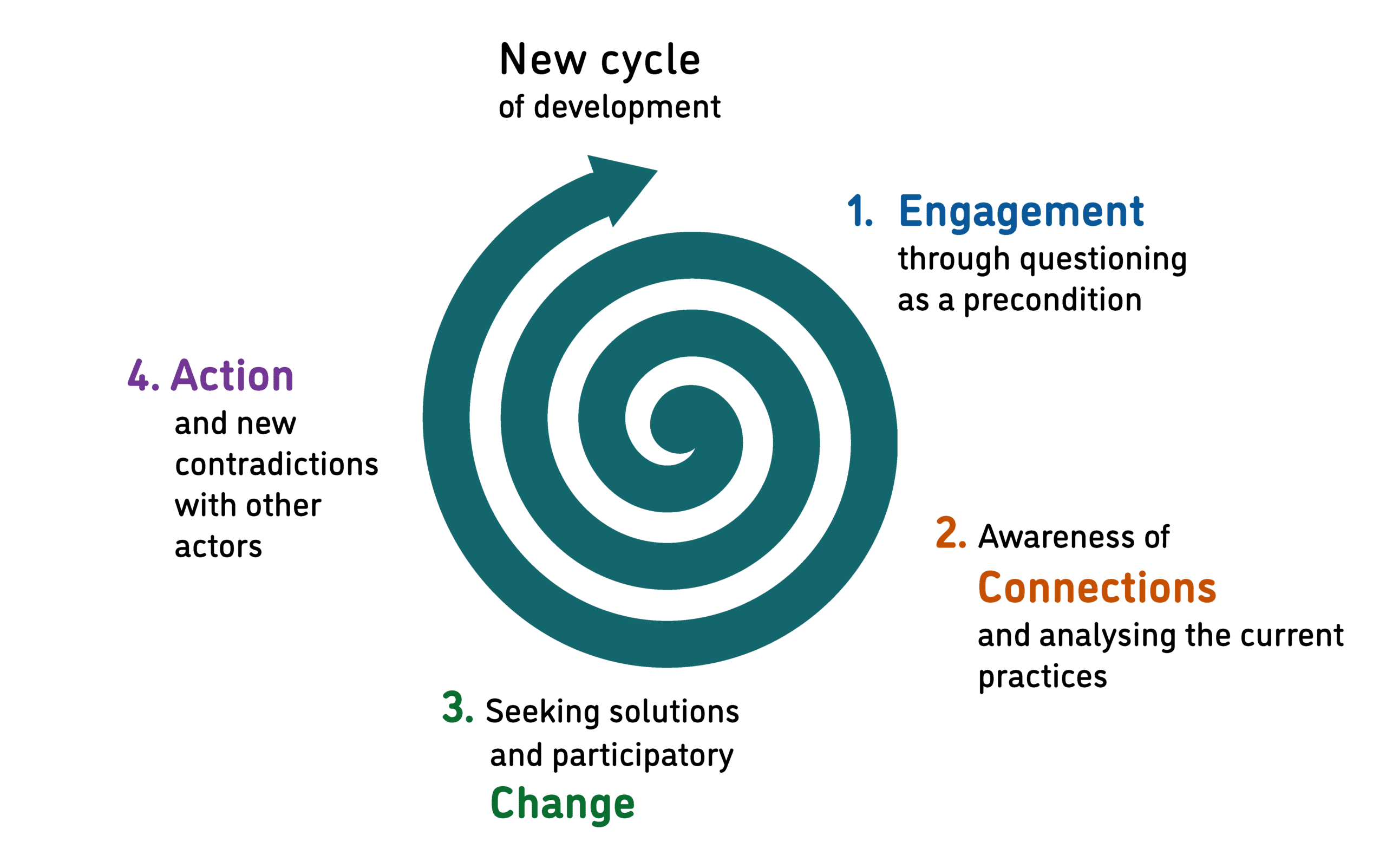
The process toward sustainability in a school or university begins when someone becomes engaged in improving sustainability. This engagement may stem from personal concern about the state of the planet – shaped by societal zeitgeist, media, and public discourse – knowledge of ecological crises, or personal experiences, such as local impacts of climate change (e.g., droughts, floods, biodiversity loss of once-common and cherished species). It may also arise from practical knowledge, such as environmental measurements at the school that reveal the institution’s or an individual’s impact on climate change. Engagement can also be triggered by administrative or peer pressure, prompting actors to prioritise sustainability. When a contradiction arises between sustainability engagement and existing practices the motivation to promote sustainability increases. In the best-case scenario, engaged teachers, headmasters, students and the institution as a whole are willing to transform the aims and values of education to reflect a new understanding of the planet’s condition. Without such contradictions, motivation to promote sustainability remains low – business as usual is easier when there is no genuine drive for change.
Awareness of sustainability’s importance leads to scrutiny of current practices. What are the connections between these practices and sustainability? What are the root causes of unsustainable practices? What problems exist in current activities? These discussions foster an understanding of contradictions between current activities and sustainability goals. Such contradictions may manifest in individual behaviours, collective practices, or technical-material arrangements – highlighting the gap between traditional methods and new sustainability aims. For example, subject-based teachers may wish to incorporate sustainability content into their teaching but struggle with limited time and the importance of existing content.
Once unsustainable behaviours, practices or structures are identified, the next step is to seek solutions: What changes are important in our context? A participatory approach helps identify the best models for each context through collaborative elaboration. However, contradictions with other institutional activities often arise. For instance, promoting multidisciplinary teaching at a university challenges traditional administrative and financial structures, as funding is typically allocated through faculties. Deciding which faculty receives funding when multiple faculties are involved can be difficult, creating pressure to reform these structures. In secondary schools, the desire to teach in natural surroundings may conflict with rigid schedules, making it hard to travel to and from natural settings between lessons.
Ideally, after navigating these contradictions, the school or university enters the action phase, establishing new practices. However, a new contradiction often emerges: the institution’s activities may not align with the broader system it operates within. For example, a school may set up recycling stations, but if the waste management service collects all waste in a single plastic bag, the effort fails to achieve its goal. In the best case, this contradiction motivates the service provider to change its practices and to enter its own transformation cycle.
The development cycle does not end here. New challenges will arise, prompting the process to begin again. Members of the school or university community can join this transformation cycle at any point, experiencing their own mini-cycles of engagement, reflection, change, and action.
Materials and tools developed in ECF4CLIM project
-

Collection of materials and tools
To collectionYou find old and new materials and tools created in ECF4CLIM project in MAPPA collection
-
Environmental footprint calculator
Environmental footprint calculatorThe Footprint calculator enables users to assess the environmental impact of behaviours and operations enables users (managers, students, teachers, personnel, families) to assess the environmental impact of behaviours and operations. The Footprint calculator is based on a Life Cycle Assessment (LCA) methodology. -
Learning space of ECF4CLIM project
Learning spaceThe Learning Space encompassing educational resources was developed to enhance citizens’ awareness and capacity to combat climate change and foster sustainable development. These educational materials consist of interactive educational resources made for students, educators and the wider educational community.
-
Roadmap learning game
Roadmap learning gameA learning game inspired by the Roadmap for Sustainability Competences.

The Roadmap for Sustainability Competences was developed during the ECF4CLIM-project, through a transdisciplinary and participatory process conducted in four European countries—Spain, Finland, Portugal, and Romania—with the support of technical partners in Hungary and Greece. ECF4CLIM developed, tested, and validated this Roadmap for Sustainability Education through multiple phases. Data was collected through crowdsourcing, and the initial roadmap was tested using participatory action research in project schools and universities. Throughout its development the roadmap was assessed both internally and externally.